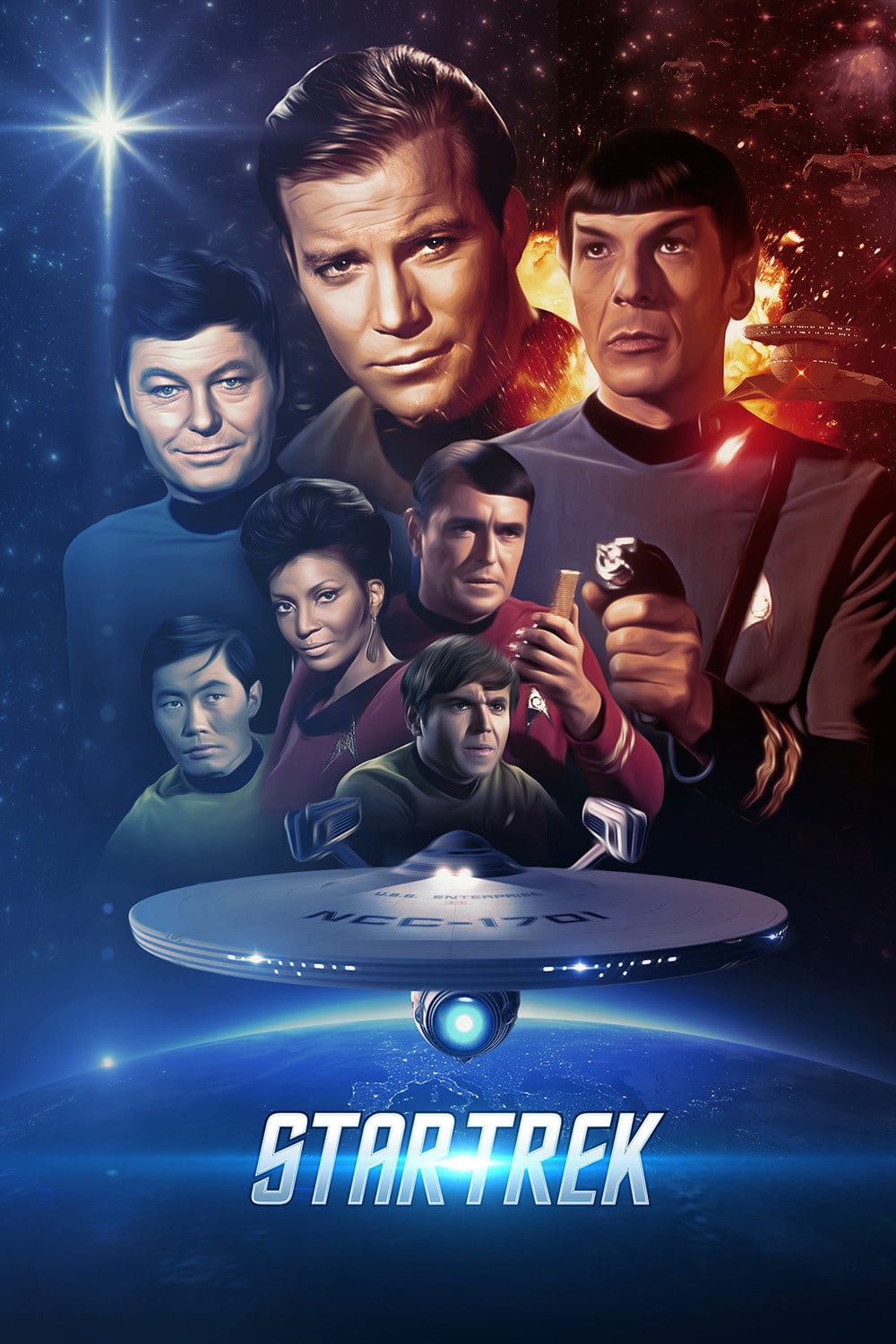
In the spring of 1969, NBC broadcast the final episode of Star Trek (1966) with the quiet indifference of a network taking out its own garbage. Ratings had declined. The budget had been cut so severely that the third season's production values became a recurring punchline. The show was cancelled. By any standard industrial metric, that was the correct decision. What happened next was not.
Sixty years after its premiere, Star Trek is not merely a surviving franchise. It is the founding document of how modern entertainment audiences organize themselves, advocate for what they love, and ultimately compel industries to reverse their own conclusions. As Star Trek: Strange New Worlds (2022) counts down to its season finale and the 60th-anniversary wave of theatrical screenings, limited collectibles, and — in perhaps the most perfectly on-brand tribute imaginable — an ESA astronaut wearing a Captain's Delta badge aboard the International Space Station continues to ripple outward, the occasion demands more than celebration. It demands autopsy. Not of the show itself, but of the machine its audience built around it, and the degree to which that machine became the template every subsequent fandom has operated from, consciously or not.
The Letter Campaign as Political Technology
The first mechanism worth understanding is the one that saved the show before its cancellation, and then, in a different form, defined what happened after. In 1967, facing the end of its second season, Star Trek was kept alive by an organized letter-writing campaign that delivered an estimated one million pieces of correspondence to NBC. The network renewed it for a third season largely as a response to that volume. This is frequently told as a heartwarming story about passion overcoming commerce. It is more accurately understood as the first large-scale demonstration that a television audience could function as a political constituency.
The campaign was not spontaneous. It was coordinated by Bjo Trimble, a science fiction fan and organizer who recognized that the audience for the show was literate, networked through existing SF fandom infrastructure, and capable of collective action. She was right. What she constructed was, in effect, an early lobbying operation — targeted, persistent, and fluent in the language of institutional pressure. NBC capitulated not because executives suddenly appreciated the show's humanism, but because the cost of ignoring the campaign had become higher than the cost of renewal. That calculus — audience organization as leverage — has never stopped being true. It simply took the rest of the industry several more decades to fully internalize it.
The Convention as Infrastructure
The cancellation, when it finally arrived, did not dissolve the audience. It concentrated it. The first Star Trek convention was held in New York in January 1972 — three years after the show went off the air — and it drew roughly three thousand attendees against an expectation of perhaps five hundred. The organizers ran out of merchandise on the first day. The hunger was not nostalgic in the sentimental sense. It was structural. The audience had been built to consume and discuss a text that no longer had new material, and so it began producing its own: fan fiction, fan art, newsletters, debates about canon conducted with the seriousness of Talmudic scholarship.
What emerged from those early conventions was not a subculture in the pejorative sense but a parallel publishing and creative economy. Fanzines — self-produced, photocopied, distributed through postal networks — created a circuit of critical and creative engagement that existed entirely outside official channels. The franchise's rights holders had no meaningful role in this ecosystem. It ran on enthusiasm and the surplus intellectual energy of an audience that had been handed a richly detailed universe and then told the show was over. The convention circuit formalized this energy, gave it annual gathering points, and — crucially — demonstrated to anyone paying attention that the audience's commitment to the property was durable in a way that Nielsen ratings had never captured.
Syndication and the Economics of Devotion
The mechanism that translated fan devotion into institutional survival was syndication. After cancellation, Star Trek's seventy-nine episodes entered local syndication markets and, critically, performed better in reruns than they had in their original network run. The repeatable-viewing behavior of the core audience — people who watched the same episodes multiple times, who introduced the show to new viewers, who drove up local ratings in markets where the network had never given it adequate promotion — produced a syndication revenue stream that NBC had not anticipated and did not control. By the mid-1970s, the property's commercial value was self-evident in a form that required no critical consensus or executive advocacy. The numbers made the argument.
This is the economic lesson the entertainment industry absorbed slowly and then all at once. A sufficiently devoted audience does not behave like a normal consumer base. It rewatches. It recruits. It sustains a property's commercial value across gaps in new content that would ordinarily be fatal. The syndication performance of Star Trek in the 1970s is the direct ancestor of the streaming-era logic that drives decisions about franchise maintenance today — the understanding that a loyal fandom is an annuity, not a one-time transaction. Every studio that now manages a tentpole franchise as a long-term relationship rather than a hit-or-quit gamble is operating on principles that Trekkers demonstrated empirically between 1969 and 1979.
The Franchise as Civic Institution
What distinguishes Star Trek's fandom from mere brand loyalty is ideological coherence. The show offered a specific vision of the future — pluralist, exploratory, defined by collective problem-solving over individual heroism — and the audience that formed around it internalized that vision as something closer to a civic identity than a consumer preference. This is why the Delta badge on the ISS is not a publicity stunt. It is a legible statement inside a community that has spent six decades treating the show's optimism as a credible proposition about what humanity could be.
Strange New Worlds understands this. More than any other entry in the modern franchise era, it has engaged the original series' tonal register — episodic, morally explicit, willing to be sincere without irony — and found an audience that responds to that sincerity with the same intensity the original viewers brought to their letter campaigns. The show is not trading on nostalgia. It is demonstrating that the architecture of the original text still generates the same kind of attachment, in new viewers who have no personal memory of 1966, because the architecture was never really about the period. It was about the model of engagement it invited: serious, participatory, community-forming.
What the Industry Learned, and When
The full lessons of Star Trek's fandom were not absorbed cleanly or quickly. Hollywood spent most of the 1970s and 1980s treating devoted audiences as anomalies rather than templates. The franchise's own revival — Star Trek: The Motion Picture (1979), greenlit only after the success of Star Wars (1977) convinced Paramount that science fiction had commercial scale — came from the wrong diagnosis. The executives who approved it were responding to box office trends, not to the decade of fan organization that had kept the property alive. The fans had already done the work of proof. The industry needed a different data point before it could see what had been in front of it.
By the time Star Trek: The Next Generation (1987) launched directly into first-run syndication — bypassing the network model entirely, in a decision made possible by the original series' syndication track record — the fandom's structural value had finally been codified into production strategy. The franchise was now being built around the audience's behavior rather than despite it. Every subsequent franchise that has been managed with fandom infrastructure in mind, from Star Wars' convention ecosystem to the letter campaigns that saved Cobra Kai (2018) and Manifest (2018), is running a version of the same playbook.
At sixty, Star Trek is the oldest continuously relevant franchise in American popular culture. That longevity is not accidental, and it is not simply a function of quality. It is the product of an audience that was handed a cancellation notice and responded by inventing, from scratch, the infrastructure of modern fandom. The industry spent fifty years learning to recognize what that infrastructure was worth. The fans knew on the first day.