Forget the streaming algorithms and the trade-publication trend reports. If you want to know what the culture was actually frightened by in a given year, look at what Heidi Klum chose to wear to her own Halloween party. Not what she said in the press run-up. Not the Instagram teaser. The finished thing — the fully realised, prosthetics-laden creature she walks out as, after months of planning and sometimes a full working day in the makeup chair. That is the honest cultural artifact. Everything else is commentary.
Klum has hosted her annual Halloween bash since 2000, enforcing a strict no-costume, no-entry rule for all guests. Twenty-six years of that discipline have produced something no entertainment editor planned: an unbroken, single-source index of what pop culture feared, celebrated, and fixated on, year by year. The party is called Heidiween now, a portmanteau that quietly concedes the event has outgrown any individual host. It is its own institution.
The archive rewards reading. In 2015 Klum dressed as Jessica Rabbit, the iconic bombshell from Who Framed Roger Rabbit (1988), at a moment when nostalgia for analogue sexuality — the kind that predated the algorithm — was surging across fashion and film. The transformation reportedly took nearly ten hours and involved full prosthetic work. Two years later, she dressed as one of the werewolves from Michael Jackson's "Thriller" video — a choice that arrived exactly when culture was beginning its most serious reckoning with Jackson's legacy, even if that reckoning wouldn't fully detonate until 2019. In 2018 Klum dressed as Princess Fiona while her husband, Tom Kaulitz, joined her as Shrek, a franchise whose ironic tenderness had by then become a genuine meme-era totem. In 2022, Klum arrived on the Halloween scene transformed into a giant worm, lying on the floor to fully embody her role. It was the year of parasocial collapse, of people watching other people eating on camera, of the viral video as the dominant art form. A giant invertebrate demanding to be looked at was, arguably, correct.
The costumes are not passive reflections. Her commitment to the season has forced a generation of celebrities to up their game, and even with renewed competition, Klum's no-holds-barred approach remains in a class of its own. She goes big and she goes grotesque, whether it's that hyper-real worm outfit or the uncanny recreation of Jessica Rabbit that was more cartoony than the real thing. The commitment is the point. Each costume is an argument that the thing it references is worth this much effort — worth months of planning, worth the physical discomfort, worth making your face unrecognisable to your own children. That is a different kind of cultural endorsement than a magazine cover or a brand deal.
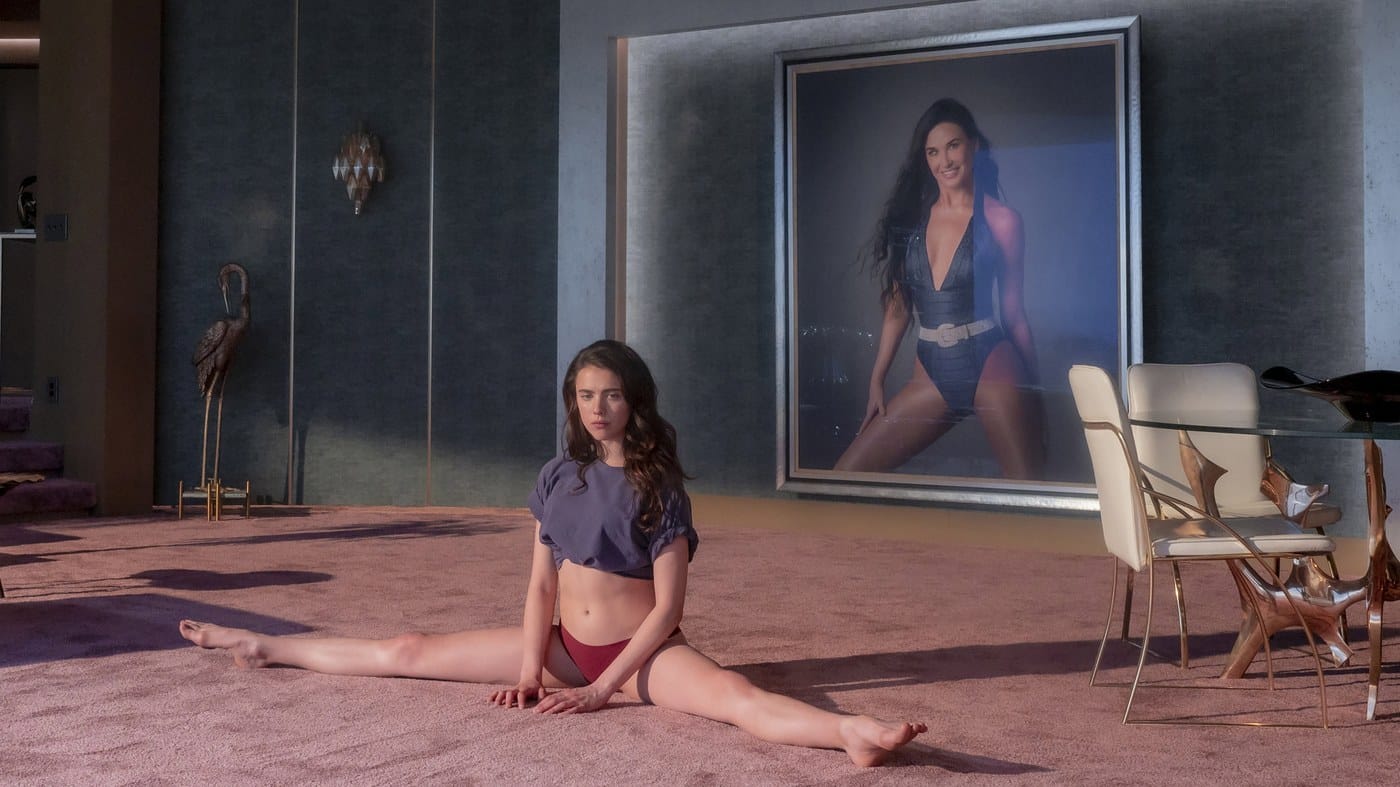
Which brings us to 2026, and to what the teasers are suggesting about where Klum has pointed her considerable apparatus this time. In an Instagram post, she shared a close-up photo of what appears to be a set of prosthetic organs, and separately teased that the costume will be "very, very bloody" this year. In the past week, Klum shared social media posts teasing her costume with images of slimy, intestinal-shaped objects and tentacles. The internet moved quickly. Multiple observers have concluded the costume is almost certainly something related to The Substance (2024), with the clues screaming Monstro Elisasue — the grotesque amalgamated creature from the film's final act.
If that reading is correct, the choice is extraordinarily precise. Nominated for five Academy Awards, Coralie Fargeat's The Substance has been one of the most talked-about movies of the past two years; since its premiere at Cannes, the body horror film has divided opinions in the way it tackles themes like female empowerment, gender stereotypes, and pervading cultural beauty standards, all blended within a pronounced satire. The film ultimately won the Oscar for Best Makeup and Hairstyling — a category that is, when you think about it, the exact craft Klum deploys every October. On January 5, 2025, Demi Moore won a Golden Globe Award for her performance as Elisabeth Sparkle in the film, and the awards season conversation around The Substance ran for months, bleeding into a cultural discourse about ageism, the entertainment industry, and the violence done to women's bodies by the expectation of permanent youth.
Director Fargeat has argued that body horror is "the perfect vehicle to express the violence all these women's issues are about." In The Substance, Fargeat crafts a visceral, unrelenting tale about how the pursuit of physical perfection leads to total dehumanisation. The film did not merely frighten audiences — it made them complicit, forcing recognition of exactly which cultural systems they participate in when they consume images of female bodies. That is the anxiety that Klum, if the reading is correct, has chosen to embody — literally — in 2026.
The symmetry is almost too neat to be coincidental. Klum is herself a product of exactly the industry The Substance anatomises: a supermodel who pivoted to television, who has spent decades managing her public image against the same beauty-standard machinery the film depicts as murderous. If she walks out as Monstro Elisasue — as the thing that Hollywood's demands for eternal youth ultimately produce — she is not simply referencing a film. She is making a statement about her own biography, and by extension about every woman who has had to perform perpetual attractiveness as a professional requirement. That is a more sophisticated cultural act than a think-piece, and it will be absorbed by a far larger audience.
This is precisely what distinguishes Heidiween from the year-end listicles that will appear in December claiming to have identified the cultural moments of 2026. Those lists are assembled retroactively, shaped by editorial consensus and algorithmic traffic data. Klum's choice is made in real time, under pressure, with money and social capital at stake. It is a single bet, publicly placed, on what mattered. The Substance itself received a 13-minute standing ovation at Cannes, suggesting the film's nerve-striking wasn't manufactured by critics but was spontaneous and physical — the kind of cultural impact that leaves a mark precisely because it cannot be fully articulated in language. A Klum costume that channels that energy doesn't translate it. It amplifies it, takes it off the art-house circuit, and drops it in the middle of a celebrity Halloween party in New York City, which is to say, in the middle of the global media ecosystem.
There is also something worth noting about the longevity of the reference. Monstro Elisasue has probably become one of the most iconic characters of the year according to those who have tracked the film's afterlife, and its imagery — bodies merging, flesh refusing to behave, glamour curdling into something biological and ungovernable — has seeped into fashion, music, and visual art in ways that official year-end recaps tend to undercount because the seepage doesn't produce clean data. Klum counting it as the dominant image of 2026 is, in that sense, a more honest accounting than a chart. It is the kind of cultural intelligence that comes from paying attention rather than measuring.
On this point, the Kim Kardashian Halloween 2026 story is instructive by contrast. Where Kardashian's costume — dressing as her own daughter — turned the mirror inward and generated a conversation about identity and performance, Klum's approach has always been outward-facing: she finds the thing in the culture that has most fully captured the collective imagination and then inhabits it at a cost of time, money, and physical endurance that signals genuine respect for the reference. It is an act of cultural criticism conducted through craft. The medium is the method.
Halloween has always been the holiday that tells the truth. Children's costumes index parental anxiety; adults' costumes index desire and fear. Klum's party, which enforces dress as a condition of entry, takes that logic and raises it to a professional standard. Twenty-six consecutive years of that enforcement have produced something no institution planned: a single, reliable, annually updated record of what the culture was actually feeling, rendered in latex and stage blood and hundreds of hours of prosthetic work. Whatever walks out of that party tonight, read it carefully. It will tell you more about 2026 than most of what gets published in the next two months.
For more on how celebrity persona intersects with cultural production, see also our analysis of Houdini at 100: The Escape Artist Who Invented Modern Celebrity — a piece about another performer who understood that the body, rendered spectacular, is its own cultural argument.