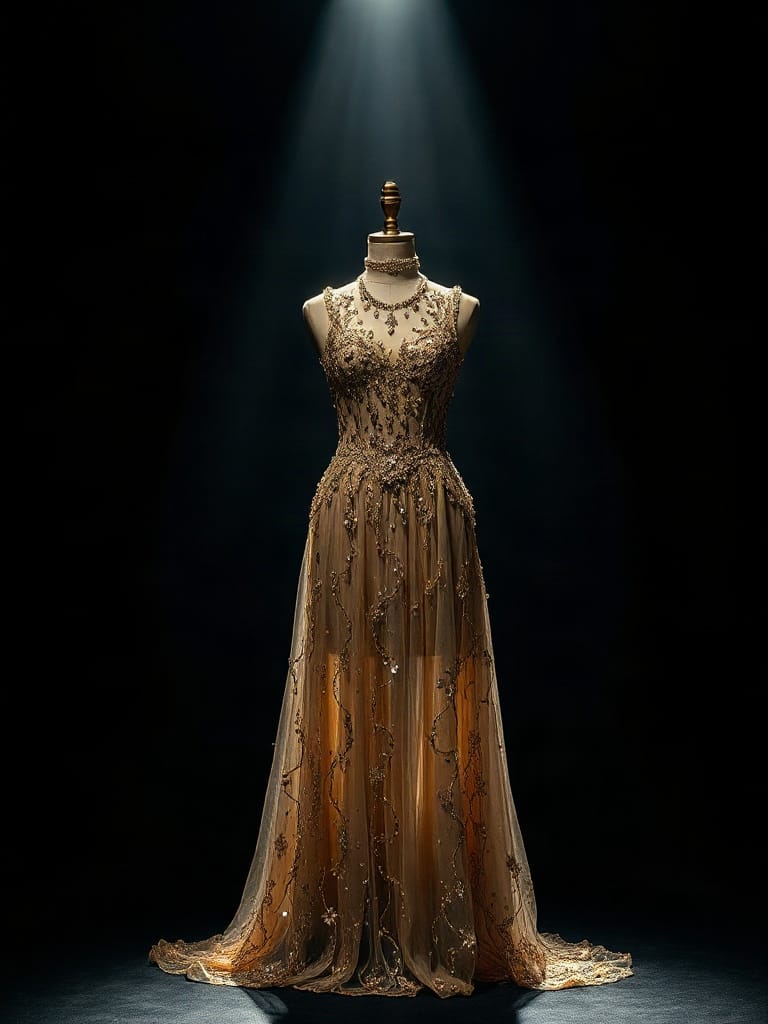
Bob Mackie died on July 3, 2025, at 87 years old, and the obituaries will call him a costume designer. They will mention Cher. They will mention Carol Burnett and Tina Turner and the naked dress and the headdress and the rhinestones — always the rhinestones. What they are less likely to say, because it requires stepping back far enough to see the whole canvas, is that Mackie did not merely dress celebrities. He authored a visual language that has since become so thoroughly embedded in performance culture that we now mistake it for nature.
That is the work of a true original: to disappear into the assumption.
Mackie came up through the sketch rooms of Hollywood television in the early 1960s, apprenticing under Edith Head and Ray Aghayan before his work found its permanent home on The Judy Garland Show and then, definitively, on The Carol Burnett Show, which ran from 1967 to 1978 and gave him a weekly national stage unlike anything available to a designer before or since. Television was live, approximate, brutal to fabric. Mackie understood that the camera needed more — more contrast, more edge, more light catching light. He gave it exactly that, and in doing so, he recalibrated what audiences understood a body on stage could look like.
The relationship with Cher is the one history reaches for first, and it deserves the reach. Beginning in the late 1960s and accelerating through the 1970s and beyond, Mackie built for Cher an aesthetic that was simultaneously armor and exposure — garments that covered almost nothing while declaring everything. The 1974 Met Gala look. The 1986 Academy Awards sheer black beaded gown with its mohawk headdress, which Mackie himself described as "a beautiful bird of paradise." The 1988 "Turn Back Time" music video bodysuit, which MTV initially refused to air in daytime rotation. Each piece functioned less as clothing than as manifesto. Cher's body was the argument; Mackie's design was the rhetoric.
What made this collaboration historically significant rather than merely spectacular is what it proved: that a woman could commandeer maximalism as a form of authority rather than vulnerability. Before Mackie and Cher, sequined showgirl excess was coded as passive — the object of the gaze, decorative, interchangeable. Mackie's designs were aggressive in their specificity. They were not costumes that could belong to anyone. They were architecture built for one tenant, and they telegraphed, in every crystal and cut-out, that the woman wearing them had chosen this, weaponized this, owned this.
That distinction matters enormously when you trace the lineage forward.
Drag performance — particularly the post-RuPaul's Drag Race (2009) wave that pushed drag into mainstream visibility — owes Mackie a debt that is rarely itemized properly. The logic of drag construction, the idea that glamour is a discipline with moral weight and theatrical consequence, that the more impossible the silhouette the more genuine the statement — this is Mackie's grammar, spoken in a different accent. When a contestant on that show walks a runway in thirty pounds of hand-sewn beading, she is operating in a tradition Mackie formalized. He demonstrated, decade after decade, that excess executed with precision is not vulgarity. It is virtuosity.
The MTV Video Music Awards, which launched in 1984, became the other great theater for this inheritance. The VMAs understood early that music television required a visual register calibrated to compete with the music itself — that performance on that stage needed to arrive as image before it arrived as sound. Madonna, Beyoncé, Lady Gaga, Nicki Minaj, Rihanna: the visual vocabulary those artists deployed at the VMAs — the nudity-adjacent, the fantastical, the body as spectacle-object — runs directly back through Mackie's decades of proof that this register was possible, permissible, and powerful. Mackie did not design for those performances, but he designed their permission slip.
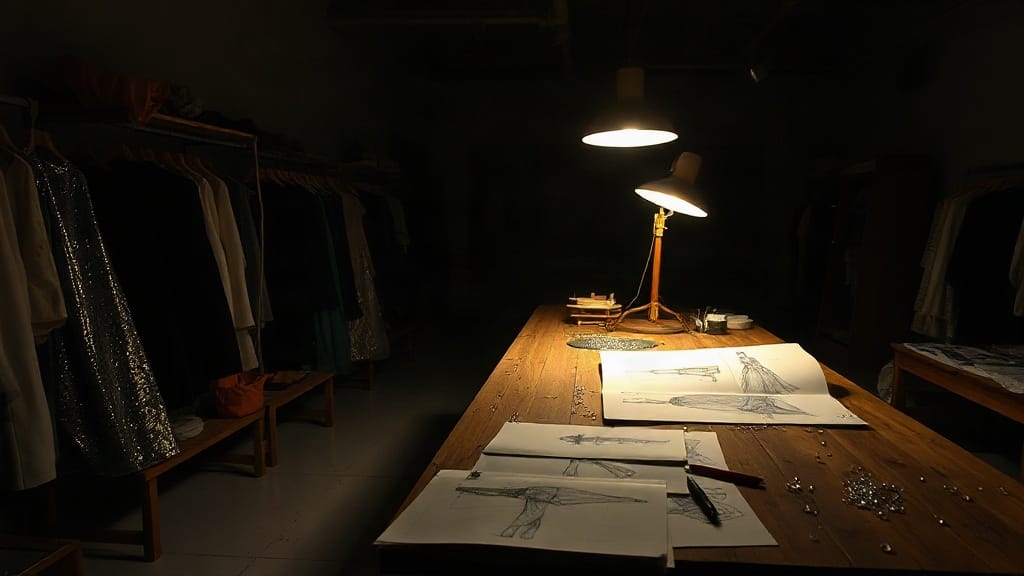
It is also worth being precise about his craft, because the cultural analysis risks making Mackie sound like a theorist when he was, first and finally, a maker. He could sketch at extraordinary speed — his output during the Burnett years alone constituted thousands of designs across eleven seasons — and his sketches were famous for their specificity, their sense of movement, their understanding of how fabric behaves under stage light versus camera light versus the particular cruelty of the television close-up. He did not delegate the difficult technical problems. He solved them. The structural engineering required to keep a body visible while draping it in ten thousand individually sewn stones, the physics of a headdress that must remain stable through a full production number, the geometry of a nude illusion gown that must read as daring from the third row and the twenty-third row simultaneously — these are not aesthetic decisions. They are problems. Mackie was a problem solver who happened to solve problems in sequins.
What is mourned now, alongside the man, is a particular kind of confidence. Mackie worked in an era when television variety and Hollywood ceremony were the dominant stages of popular culture, and those stages rewarded a certain unapologetic largeness. His maximalism was not a reaction to minimalism or a provocation against restraint — it was simply the natural output of a sensibility that believed more was more, and that more, executed with enough intelligence and precision, became something else entirely: a vision.
Contemporary fashion cycles through maximalism and minimalism with the rhythm of a tide, and periodically critics declare that excess is back, that the naked dress has returned, that glamour is having a moment. These declarations tend to treat maximalism as a trend rather than a tradition. Mackie's career is the corrective. He did not participate in cycles. He built a body of work across six decades that held its own logic and its own internal standard, and that standard was always the same: Does this make the person wearing it impossible to ignore? Does it make them more themselves, or less? Does the spectacle serve the performer or consume her?
By that standard, almost everything Mackie made was a success.
The loss at 87 is not premature. It is still, somehow, a subtraction — the closing of a practice that was irreducibly his, that cannot be apprenticed into or inherited whole. His archive exists. His sketches exist. The photographs of Cher at every awards show and music video set and concert tour exist, and they will continue to circulate, to be referenced, to be cited by designers who may not even know the citation they're making. That is the deepest form of influence: when the source becomes invisible because the lesson has been so completely absorbed.
Bob Mackie spent sixty years making the invisible visible — the structure beneath the sequin, the statement beneath the skin. It is fitting, and a little melancholy, that the culture now returns the favor.