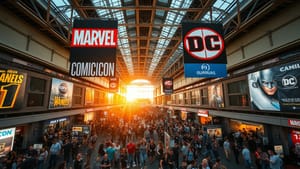
San Diego Comic-Con has always been a pressure test disguised as a celebration. From July 22 to 26, 2026, the convention center on Harbor Drive will once again function as the industry's most public diagnostic — a place where enthusiasm is real but the subtext is all business. This year, the subtext is unusually loud.
Marvel arrives at SDCC 2026 without C.B. Cebulski at the helm for the first time since 2017. His departure, confirmed in late spring, closes a chapter defined by a relentless push for accessibility — Fresh Start, Outlawed, Destiny of X, wave after wave of relaunches that kept the line moving without always keeping it coherent. The results were commercially mixed and creatively uneven. What they were not was timid. Cebulski bet on volume. The question his successor now inherits is whether volume was ever the right bet.
Steve Wacker is not a neutral appointment. His fingerprints are on some of the most critically durable Marvel runs of the 2000s and early 2010s — the Amazing Spider-Man Brand New Day era, Daredevil under Mark Waid, the scaffolding of what the Marvel Knights aesthetic eventually became. He is an editor who has historically prioritized craft over event mechanics, character coherence over crossover logistics. That profile matters enormously in the current climate, because the climate has shifted in ways Marvel cannot afford to misread.

What DC's Absolute Universe Is Actually Proving
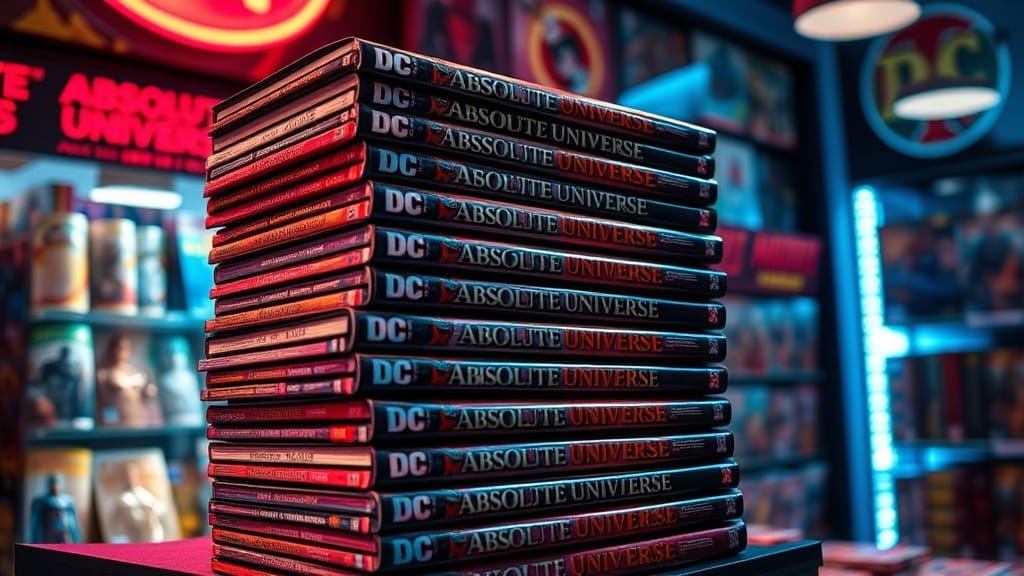
DC's Absolute Universe — launched in late 2024 and now firmly embedded in the top tiers of the back-issue and ongoing sales charts — is not just a line. It is an argument. The argument is that readers will pay attention, and pay full cover price, for comics that commit to a singular vision rather than retrofitting continuity. Absolute Batman, Absolute Superman, Absolute Wonder Woman: each title operates as a contained, high-concept reinterpretation with enough creative autonomy to feel genuinely distinct from the mainline DC universe. The market has responded accordingly.
For Marvel, watching that line dominate the backlist conversation is not merely competitive pressure. It is diagnostic information. The readers gravitating toward DC's Absolute books are not newcomers who wandered in from a movie theater. They are longtime comics readers — precisely the demographic Marvel has struggled to retain through successive continuity resets. The implication is uncomfortable: Marvel's churn strategy may have optimized for new entry points at the cost of sustained engagement.
SDCC as the First Real Thermometer
Wacker's first major public moment as Editor-in-Chief will unfold across these five days in San Diego, and the industry will be reading every panel, every announcement, and every absence for signal. The questions circulating ahead of the con are specific: Does Marvel use SDCC to announce another universe-wide event, doubling down on the infrastructure that has defined its publishing rhythm for two decades? Or does Wacker's team signal something architecturally different — fewer moving parts, longer creative runs, a deliberate slowing of the relaunch cycle?
The answer will not come from a single announcement. It will come from the pattern of what is announced, who is attached to what, and how the editorial voice frames the line's identity. Wacker is a precise communicator with a track record of making creative rationale legible to readers. If the new direction has substance, SDCC is where the grammar of that direction begins to become visible.
The Stakes Beyond Market Share
There is a larger question underneath the commercial one. Mainstream American comics — Marvel and DC, specifically — have spent the better part of a decade navigating a cultural moment in which their characters are more famous than their comics. The MCU and DCU have made household names of characters whose monthly books sell a fraction of what they sold in the 1990s. That gap between IP visibility and comics readership is not a marketing problem. It is a content problem. The medium has to justify itself on its own terms, independent of what happens on a streaming platform.
DC's Absolute Universe suggests one answer: lean into the formal possibilities of the comic book page, strip away the connective tissue of shared-universe obligation, and trust readers to follow a strong creative vision. Marvel under Wacker may arrive at a different answer. But it has to arrive at one.
San Diego Comic-Con 2026 is not the moment that decides Marvel's next decade. It is the moment the decision becomes audible. The industry will be listening with unusual care.