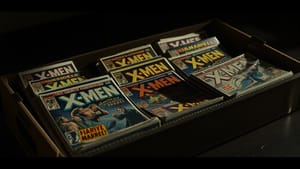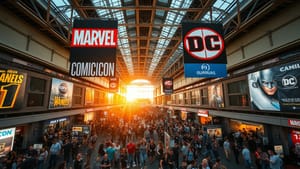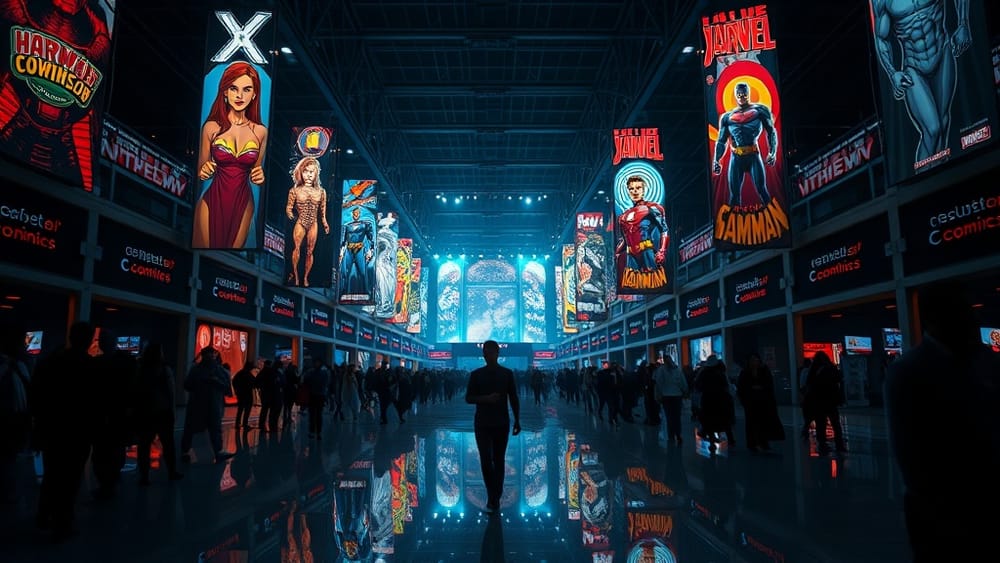
San Diego Comic-Con 2026 is doing what it always does: containing multitudes. This week, the convention floor holds the Eisner Awards ceremony — the industry's closest equivalent to the Oscars — Marvel's loudest symbiote event in years, and the fallout from a webcomic cancellation that has reopened every conversation the medium keeps trying to close. Three stories, one fault line.
The Eisners, Earned and Contested
The Eisner Awards represent the sharpest annual snapshot of where comics think they are. Voted on by industry professionals and announced at SDCC, they carry genuine weight — not because the ceremony is glamorous, but because the nominations force a reckoning with what actually got made. This year's slate leans heavily into literary graphic novels and creator-owned work, which says something about where critical consensus has moved even as superhero IP continues to generate the revenue that keeps the lights on. The tension between those two realities is not new. What is new is how uncomfortable the industry looks holding both of them at the same time, in the same convention center, in the same week.
The Eisners reward excellence. They do not, by design, address accountability. That gap matters more than usual right now.
Queen in Black and the Architecture of a Marvel Summer Event
Queen in Black (Marvel, 2026) is the kind of event comic Marvel knows how to build in its sleep: a symbiote cosmology expanding to cosmic scale, a female antagonist positioned as the dark mirror to established heroes, tie-in issues seeded across a dozen titles. The architecture is clean. The hook — a new symbiote deity threatening to subsume every bonded host on Earth — is functional enough to sustain a six-issue spine and justify the crossover footprint.
What makes Queen in Black editorially interesting is not the plot mechanics but the timing. Marvel is releasing this during a convention week when the critical conversation is loudest, betting that spectacle and scale will dominate the discourse. It is, in many ways, a deliberate counterweight to the more introspective work the Eisners are celebrating. Neither approach is wrong. But placing them side by side this week makes the contrast impossible to ignore: the industry's prestige arm and its commercial engine running at full power simultaneously, each pretending the other is not in the room.
The series also leans into Knull's expanded mythology established in King in Black, which means it is speaking primarily to readers already inside the symbiote continuity. As a gateway event, it is less interested in recruitment than in reward. That is a strategic choice with real consequences for readership growth — a problem the direct market cannot afford to keep deferring.
Song of the Wasteland and the Cancellation That Wasn't Just a Cancellation
Song of the Wasteland, a post-apocalyptic webcomic that had built a dedicated following over three years, was cancelled this week by its publisher following community-documented evidence of racist caricature in its character design and worldbuilding. The patterns identified — darkened skin tones coded as villainy, exoticized cultures rendered as set dressing, a protagonist whose heroism was structurally dependent on the dehumanization of non-white supporting characters — were not subtle. They were systemic.
The publisher's statement was swift and, by current standards, technically adequate: acknowledgment, apology, cancellation. What it did not include was any account of how the work passed through an editorial pipeline without intervention. That silence is the actual story. Cancellation is an endpoint. It tells us nothing about the process that makes such work possible — the acquisitions meetings, the editorial notes that were not written, the sensitivity reads that were not commissioned, the power dynamics that make junior editors reluctant to flag what senior editors prefer not to see.
Cancellation is an endpoint. It tells us nothing about the process that makes such work possible.
The timing — a racially charged cancellation landing during the same week as the industry's most prestigious awards ceremony — is not ironic. It is instructive. The Eisners can honor the medium's best impulses without addressing its structural failures. Queen in Black can dominate the commercial conversation without engaging the critical one. And Song of the Wasteland can be cancelled without anyone being held accountable for how it got made.
One Convention, Three Verdicts
SDCC 2026 is not a celebration interrupted by controversy. It is an accurate portrait of an industry at full operational capacity: rewarding brilliance, manufacturing spectacle, and absorbing scandal with just enough institutional response to avoid structural change. The Eisners will be handed out. Queen in Black will ship. The creators of Song of the Wasteland will move on, and so will the editors who greenlighted it.
The medium is capable of extraordinary work. This week proves it. The medium is also capable of extraordinary negligence. This week proves that too. The question SDCC never quite gets around to answering is whether those two facts are connected — and whether anyone in that convention center is willing to find out.