The third trailer for Overgeared (2025) landed this week, and the conversation it reignited was not really about animation quality, voice casting, or even the October 2 premiere date. It was about numbers. Stat windows, skill trees, item grades, blacksmithing durability thresholds. The comment sections filled with veterans of Park Saenal's original web novel and its manhwa adaptation doing the arithmetic on what a single cour of television can possibly contain before the whole structure buckles. That anxiety is not unfounded. It is, in fact, the most honest critical question the show has to answer.
What Overgeared Actually Is
Overgeared began as a Korean web novel serialized from 2014 onward, eventually crossing one thousand chapters before its conclusion. The premise is familiar at a glance — a down-on-his-luck gamer named Shin Youngwoo, who plays under the handle Grid, stumbles into a legendary class within the VRMMO Satisfy and uses it to claw his way from the bottom of the server's social hierarchy to its apex. The class in question is Pagma's Descendant, a blacksmith-warrior hybrid that lets Grid craft equipment of theoretically unlimited power. The fantasy is not combat supremacy in the conventional sense. It is optimization. Mastery of systems. The satisfaction of understanding a game's architecture better than anyone else and bending it until it breaks in your favor.
That distinction matters enormously for any adaptation. The genre label "gaming fantasy" covers a wide spectrum, from power-fantasy wish fulfillment (Sword Art Online, 2012) to satirical deconstruction (Log Horizon, 2013) to dungeon-crawl action (That Time I Got Reincarnated as a Slime, 2018). Overgeared sits in a category closer to Log Horizon than anything else — its dramatic engine runs on the pleasure of systems thinking, of watching a protagonist who is not especially brilliant or physically gifted succeed because he is more patient, more meticulous, and more willing to grind than anyone around him. Grid is not likable in the conventional protagonist sense, at least not initially. He is petty, status-obsessed, and socially stunted. His growth arc is inseparable from the mechanical arc. You cannot adapt one without the other.
The Translation Problem
Anime has a complicated relationship with the stat-screen aesthetic that defines the gaming-fantasy subgenre. The visual shorthand — floating UI elements, damage numbers, skill activation popups — was practically invented by Sword Art Online and has since calcified into a set of conventions that range from functional to numbing depending on execution. The challenge for Overgeared's production is that its source material is not merely decorated with system windows. The systems are the narrative. Grid's blacksmithing sequences are not montage filler between fights. They are the show's equivalent of heist-planning scenes — granular, deliberate, full of decisions that carry consequence chapters later.
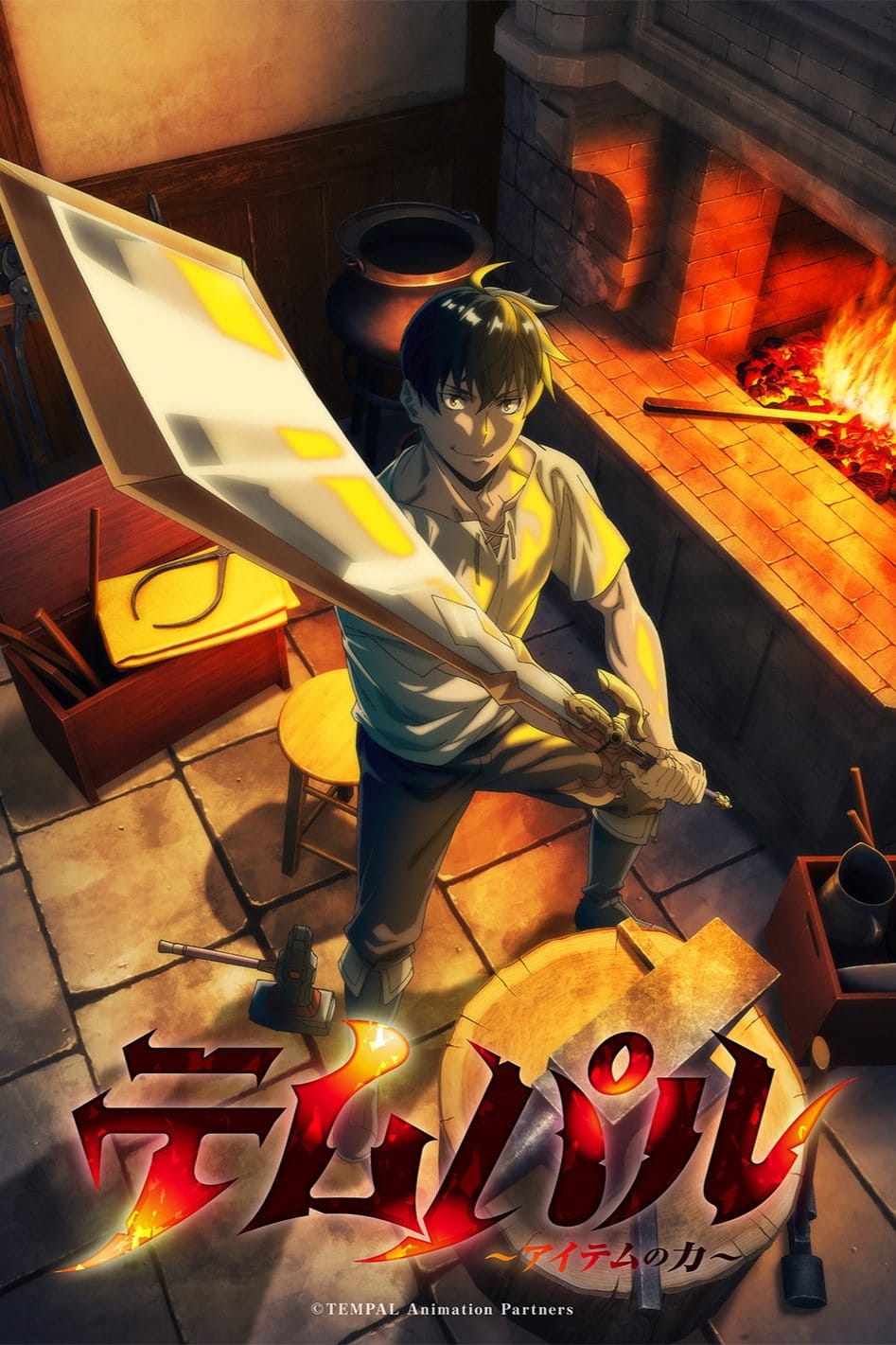
The third trailer suggests the production team at Studio Madhouse is aware of this, though awareness and execution are different things. The footage leans into the workshop sequences with unusual patience for a promotional cut. There are close-ups of forging animations, UI overlays rendered with enough visual texture to avoid feeling like PowerPoint slides, and a color language that distinguishes clearly between Satisfy's in-game environments and the real-world spaces Grid inhabits outside the capsule. The tonal register is darker and more deliberate than the trailer for the manhwa's earlier animated teaser, which played the material broader and more kinetic. Whether that patience survives contact with a broadcast schedule is the open question.
Korean IP and the Adaptation Machine
It is worth stepping back to frame what Overgeared represents beyond its own story. Korean webtoon and web novel IP has been feeding the anime pipeline with increasing aggression over the past several years. Solo Leveling (2024) was the proof-of-concept moment — a Korean manhwa adaptation produced by A-1 Pictures that delivered strong first-season viewership and established that there was an audience willing to accept Korean source material without the Japanese-isekai framing they were accustomed to. Overgeared is a more complex bet. Solo Leveling's fantasy is clean and visceral: a weak hunter becomes the world's strongest. Its appeal translates into animation with minimal friction. Overgeared's appeal is more niche, more patience-demanding, and more dependent on the audience buying into Grid as a character before he becomes conventionally cool.
That is not a flaw in the source material. It is a feature that the source material's fanbase has always understood as the series' defining quality. But it creates a genuine first-season problem. A show that front-loads Grid's unlikable early characterization risks losing casual viewers before the payoff arrives. A show that softens or accelerates that arc to make the character immediately palatable risks alienating the existing fanbase and, worse, gutting the thematic architecture that makes the later story meaningful. There is no comfortable middle path. The production has to choose which audience it is primarily serving and commit.
What the Third Trailer Reveals About That Choice
The trailer does not fully resolve the question, but it offers evidence. Grid's early-game humiliation — including his reputation as one of Satisfy's worst players before the class acquisition — is shown without softening. His reactions are brittle and ego-driven in ways that track closely with the source material's portrait of him as a man whose self-worth has been damaged by years of financial failure and social marginalization. The show appears to be betting that its audience will read these as character conditions to be overcome rather than reasons to disengage. That is a bet on viewer sophistication, which is either admirable or risky depending on how the execution lands week-to-week.
The action sequences in the trailer are polished but not the primary argument being made. Madhouse's fingerprints are visible in the fluidity of the combat choreography, but the studio seems to understand that spectacle is not what will determine this show's ceiling. The sequences that appear most carefully constructed are the quieter ones — Grid alone in a workshop, examining an item's stat breakdown with the focused intensity of someone who has finally found the one domain where his obsessive nature is an asset rather than a liability. Those moments are where Overgeared either justifies its existence as an adaptation or reveals that it has mistaken its source material for something more conventionally action-oriented than it actually is.
The Standard It Has to Meet
The October 2 premiere arrives in a season crowded with returning titles and competing new entries, which makes Overgeared's early episode retention critical. If the first two or three episodes establish the show's tonal contract clearly — this is slow, mechanical, and deliberately patient, and those qualities are the point — it has a genuine path to becoming one of the more interesting gaming-fantasy anime in recent memory. If they misread the room and try to accelerate into spectacle before the groundwork is laid, the back half of a first season becomes an exercise in damage control.
The manhwa's thousand chapters are not a burden. They are evidence that Park Saenal built something with enough structural integrity to sustain enormous length. The adaptation's job is not to compress that architecture into an highlight reel. It is to identify which load-bearing elements cannot be removed without the whole thing losing its shape, and to protect those elements even when the production pressure is toward faster, louder, and simpler. Whether Madhouse has made that identification correctly is what October 2 will begin to answer.