On November 15, 2001, Microsoft shipped a console nobody needed and a game nobody was sure would work on it. Halo: Combat Evolved (2001) launched alongside the original Xbox on that date, and within four months it had become the fastest million-unit seller of any sixth-generation console game in North American history. That is the number everyone cites. The number that matters more is the one that followed: during the two months after launch, the game sold alongside more than fifty percent of all Xbox consoles. Halo was not merely a launch title. It was the reason the launch could happen at all.
 Official trailer
Twenty-five years later, on the silver anniversary that arrives this week, the franchise is mid-transfer. Halo: Campaign Evolved (2026) — a ground-up remake of the original game's campaign, rebuilt in Unreal Engine 5 and released in July by a studio that rebranded from 343 Industries to Halo Studios two years prior — has now been followed by the announcement that Activision will develop the next mainline Halo entry, with Halo Studios relegated to a support role. The franchise that defined what a Microsoft gaming platform could be now belongs, in effect, to the publisher whose catalogue Microsoft acquired for $68.7 billion. The irony completes a circle that nobody would have drawn in 2001.
This piece is not a eulogy. It is a reckoning. To understand what Campaign Evolved chose to honour, add, or quietly cannibalize, you first have to understand what the original game actually built — not as nostalgia, but as structural fact.
The Game That Wasn't Supposed to Exist
The origin story of Halo: Combat Evolved is one of the stranger pivots in game development history. Development began in 1997, and the game started life not as a first-person shooter but as a real-time strategy title — described by Bungie itself as "basically Myth in a sci-fi universe." It moved through a third-person shooter phase before arriving at what it eventually shipped as. On July 21, 1999, at the Macworld Conference and Expo, Steve Jobs announced Halo as an upcoming simultaneous release for Mac and Windows. The audience that day had no idea they were watching a future Xbox exclusive being born.
Microsoft acquired Bungie on June 19, 2000, for approximately $30 million. The acquisition was announced shortly after E3 2000, where the first trailer for Halo had been well received. Immediately after the buyout, the game became an exclusive title for the upcoming Xbox console, and Bungie rewrote the engine, converting it entirely into a first-person shooter. By September 2000, with the campaign mode still not begun, the team had less than fourteen months to ship a launch title for a console that was itself still in development. The "Combat Evolved" subtitle — now so totemic it appears in the title of the remake — was not Bungie's choice. It was added by Microsoft's marketers, who felt that Halo alone was not a descriptive enough title to compete with military-themed games already on shelves.
That chaotic provenance matters because it explains the game's structural oddness: the wide-open outdoor spaces that feel like a holdover from an RTS, the campaign's famous repetition of level geometry in its latter half, the locally networked multiplayer that had to be grafted on without the Xbox Live infrastructure that wouldn't arrive until a year later. Halo: Combat Evolved was, at the mechanical level, a compromise made under extreme pressure by a team that had been reorienting its entire project while simultaneously learning a new platform. What makes the game's cultural impact extraordinary is not that it was polished to precision — it wasn't — but that its foundational ideas were so correct that the rough edges became part of the mythology.
What the Original Game Actually Invented
The critical consensus on Halo: Combat Evolved at launch was strong but not unanimous. The game was inducted into the World Video Game Hall of Fame in 2017, with the Strong National Museum of Play citing it as a game that "re-defined players' expectations for the genre." The specific re-definition is worth naming precisely rather than gesturing at vaguely.
First: the controller problem. In an era when PC games dominated the first-person shooter genre, the assumption was that the mouse and keyboard constituted a physical minimum requirement for the genre to function at a competitive level. Halo solved this not by ignoring the gap but by redesigning around it. Its control scheme — dual analogue sticks, with a generous aim-assist system that was invisible enough to feel like skill — became the template that every console FPS has worked from since. The game spurred a sustained trend of FPS games on consoles that had not previously existed at scale. Before Halo, the console FPS was a curiosity. After it, the genre's centre of gravity shifted.
Second: the two-weapon limit. Now so standard as to be invisible, this was a genuine design commitment in 2001. Carrying only two weapons at a time forced tactical resource decisions at every engagement. Combined with the regenerating shield mechanic — recharge by retreating to cover, not by finding a health pack — Halo created an encounter rhythm that asked players to think in phases rather than attrition. The health-pack FPS and the regenerating-shield FPS are fundamentally different games with different tempos, and Halo established the latter as viable.
Third: the vehicle integration. Warthog sections, Banshee segments, the Scorpion tank — the seamless blending of ground-infantry combat with vehicle phases, without level transitions or loading screens, made the game feel like a military campaign rather than a series of arenas. This was not unique to Halo but was executed at a quality level that set the benchmark.
Fourth, and most underrated: the audio architecture. Composer Martin O'Donnell, who had joined Bungie only ten days before the Microsoft acquisition was announced, built a score that functioned as a dynamic layer of the game rather than an ambient backdrop. The way the music shifts in real time with combat state — quiet tension, building brass, full orchestral release — is part of why a generation of players has the game's themes burned into memory with an intensity that most film scores never achieve. Halo's music plays a critical role in the franchise and in the hearts of fans around the world, as acknowledged even in the 25th anniversary programming, which includes an official full-length concert performed by the Seattle Symphony at Benaroya Hall.
Fifth: the world-building without explanation. The Halo ring itself — a Dyson-sphere fragment orbiting a dead star, later revealed as a weapon designed to starve a parasitic flood of biomass — is introduced to the player the way the game introduces everything: from inside the experience, with no briefing. You crash-land. You explore. You are not told what the Flood is before you encounter it. That mid-game pivot, from alien-war FPS to something that feels structurally like a horror game, remains one of the most effective tonal shifts in the medium. The game created a compelling mystery by showing everything and explaining nothing beyond a name.

The Commercial Arithmetic of an Xbox Identity
The commercial case for Halo: Combat Evolved is not complicated but is frequently underestimated. Halo is considered the Xbox's "killer app" — a label that sounds like marketing but in this case is a precise description. By April 2002, the game had sold one million units, and during the launch window it sold alongside more than fifty percent of Xbox consoles. By July 2003 the total reached three million copies; by January 2004, four million; by November 2005, over five million. These numbers were achieved without the benefit of Xbox Live, without a sequel's halo effect, and in direct competition with a PlayStation 2 install base that was already enormous.
The franchise that grew from this single title went on to sell over 81 million games as of March 2021. Halo 2 (2004) moved 8.46 million units. Halo 3 (2007) moved 14.5 million. At those peaks, Halo was not merely Microsoft's best-selling franchise — it was the reason that competing in the console hardware market made financial sense for Microsoft at all. The franchise subsidized the infrastructure of what would become Xbox Live, Xbox Game Pass, and ultimately the acquisition strategy that led to Activision Blizzard entering Microsoft's portfolio. The line from Halo: Combat Evolved's November 2001 launch to Activision now making the next Halo game is a straight one, even if it bends in strange directions along the way.
It is also worth noting what happened to Bungie after. On October 5, 2007, Bungie announced it had split from Microsoft and become an independent company, while Microsoft retained ownership of the Halo franchise's intellectual property. The studio that built the mythology walked away from it. Microsoft assembled 343 Industries — subsequently rebranded as Halo Studios — to continue the series. In 2022, Sony Interactive Entertainment acquired Bungie for $3.6 billion, making the studio whose early work built the Xbox ecosystem a subsidiary of its primary competitor. That is the kind of irony that makes the Halo franchise's current situation feel less like betrayal and more like a long-running pattern: the game and the people who made it have always been in motion relative to each other.
The Decade of 343: Stewardship, Stumble, and Reset
The handover from Bungie to 343 Industries produced three full mainline entries: Halo 4 (2012), Halo 5: Guardians (2015), and Halo Infinite (2021). The arc is not flattering. Halo 4 was technically accomplished and narratively ambitious; it also began a drift away from the spare, mysterious tone of the Bungie games toward something more cinematically operatic. Halo 5 doubled down on a multiplayer-first philosophy that alienated campaign-focused players and shipped with a story mode widely regarded as the weakest in the series. Halo Infinite arrived in late 2021 after a troubled development cycle that had already produced a disastrous gameplay reveal, and while its open-world sandbox campaign was genuinely well received, the live-service model that surrounded it sputtered. For many fans, Infinite represented a franchise that had lost the thread — competent in parts, directionless as a whole.
It is in this context that the rebranding of 343 Industries to Halo Studios in October 2024 must be understood. The name change was announced alongside an explicit shift in direction: rather than pursuing the next new installment in the Reclaimer Saga, the studio would return to the beginning. Halo: Campaign Evolved would be its first release under the new identity. As a commercial decision, the logic is defensible. As an artistic one, it raises a question that the game's reception has since sharpened into something urgent: what does it mean to remake a game whose primary legacy is structural innovation, and to do so without multiplayer?
Campaign Evolved: The Remake and Its Contradictions
Halo: Campaign Evolved (2026) is, in its stated ambition, a ground-up remake of Halo: Combat Evolved's genre-defining campaign, coming to Xbox Series X|S, PC, and — for the first time in franchise history — PlayStation 5. The engine is Unreal Engine 5. The feature list is substantial: three new prequel missions featuring Master Chief and Sergeant Johnson, set one year before the events of the original game; nine additional weapons from across the franchise, including the Energy Sword, Battle Rifle, and Needle Rifle; vehicle improvements including a drivable Covenant Wraith tank; a vastly expanded roster of Skulls gameplay modifiers; and four-player network co-op cross-play between Xbox, PlayStation, and PC for the first time in Halo history.
The new missions have been praised. Game Informer spent a full day at Halo Studios in Redmond playing through all three prequel missions and described them as feeling "like they've always been there, expertly slotting into the original Halo experience." The visual reconstruction is thorough — the campaign was completely rebuilt with high-definition visuals, enhanced cinematics, and refined gameplay. The Skulls system, which allows players to activate modifiers like a third-person camera mode or a ground-contact damage penalty, gives the game a layer of replayability that the original never had.
The critical reception landed in genuinely positive territory, though with a particular shape. Campaign Evolved tracked an 83 on OpenCritic with 88 percent of critics recommending it, and a Metacritic score of around 80 to 81 depending on platform. Eurogamer gave it four out of five and framed it as more successful as a reinvention than as a faithful reproduction. The consensus clustering was clear: a welcome and competent modernization that did not attempt — and therefore could not achieve — the kind of radical reimagining that might have made it a definitive statement.
Player reception was a different matter. On Steam, the game fell to a Mixed rating with around 63 percent positive reviews. The Metacritic user score sat at 5.2. The Steam concurrent-player peak at launch was 25,376 — the lowest in franchise history, and a striking figure for a game carrying the most recognisable brand in Xbox's catalogue. The complaints that accumulated were specific and largely structural: no multiplayer mode of any kind, an always-online requirement for a single-player remake, performance issues on PC and in cutscenes across platforms, voice acting that some players found tonally inconsistent with the original, and a $50 price point that many long-time fans considered hard to justify for a campaign-only package.
The game reportedly became a commercial disappointment, described in GameSpot's reporting as such. Industry analyst Mat Piscatella noted that on launch day, 8 percent of total active Xbox players launched the game, 2 percent of Steam players, and just 1 percent of active PS5 players — underwhelming figures for a franchise debut on a new platform. The PS5 launch, billed as a historic crossing of the console-war threshold, topped the PlayStation Store's best-seller chart in the US while simultaneously failing to generate the player engagement numbers that would signify a genuine new audience had arrived.
That disparity — chart position without engagement depth — is the most diagnostic number in the game's commercial profile. People were curious enough to buy it. They were not compelled enough to stay.
The Multiplayer Absence: A Structural Argument
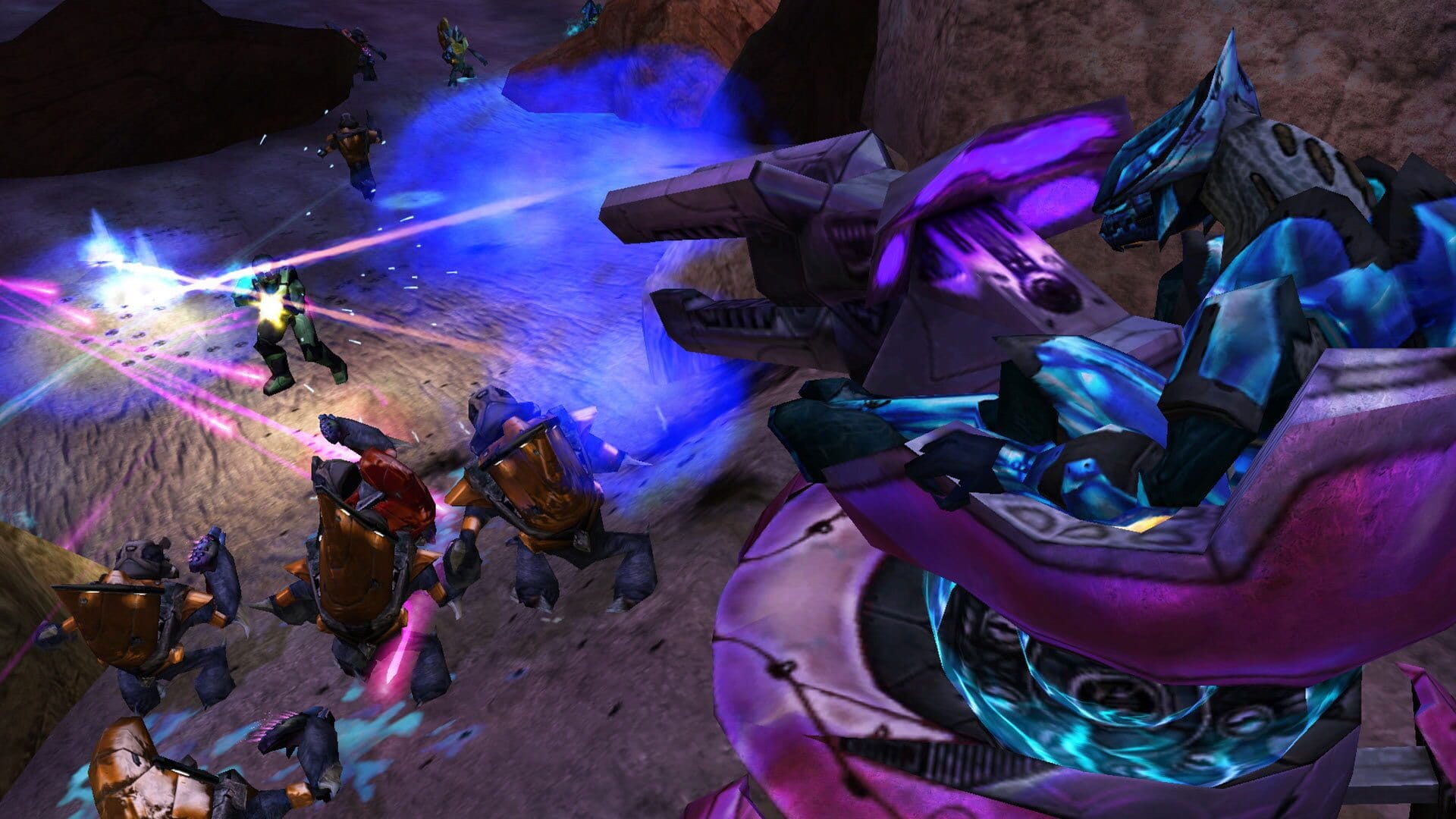
The decision to release Campaign Evolved without multiplayer is not incidental. It is the central artistic and commercial choice the game makes, and it is the one most responsible for the fracture between critic praise and player frustration.
The original Halo: Combat Evolved had no Xbox Live multiplayer — the service did not yet exist. But it had local area network play that was, for 2001, extraordinary. The game's split-screen co-op and competitive LAN sessions created a social ritual around the Xbox that had no precedent on consoles. Dorm rooms, living rooms, basements with four televisions networked together: Halo's social footprint was inseparable from its physical presence. The mythology of the game is not just the Flood reveal or the Library level or the music — it is the memory of playing it with other people in the same room, on hardware that made that feel like a shared event rather than parallel consumption.
A remake that excises this dimension is not simply incomplete. It is misreading the original's legacy at the structural level. The campaign was where the lore lived. The multiplayer was where the culture lived. Campaign Evolved chose the former and left the latter to the existing Master Chief Collection — an argument that makes commercial sense in a Game Pass ecosystem but feels inadequate as an anniversary statement.
Players were bewildered by the absence of multiplayer support, and that bewilderment was not merely about feature parity. It was about whether the studio understood what it was remaking. The answer Campaign Evolved gave was partial. It understood the campaign's narrative and its visual texture. It understood the pleasure of the prequel premise. It does not appear to have understood that for a significant portion of its intended audience, Halo was always two games in one disc, and only one of them showed up.
The Activision Handover: What It Means and What It Doesn't
Xbox Chief Content Officer Matt Booty confirmed the Activision handover in a memo titled "Continuing Our Reset," released alongside 268 additional job cuts across Halo Studios and other Xbox teams. The announcement marked the end of Halo Studios' 16-year tenure as lead developer on the franchise. Activision will build the next mainline Halo game with "a new, purpose-built team" that is explicitly separate from Call of Duty development. Halo Studios will continue supporting Campaign Evolved and The Master Chief Collection.
The framing is careful. Booty has described the next game as a "full-feature, mainline installment," not a spin-off. The Hollywood Reporter characterised it similarly. What Activision brings to the project is scale, a proven multiplayer infrastructure team, and a history of sustaining annual or near-annual live-service releases at massive volume. What it risks bringing is a design philosophy organised around engagement metrics, seasonal content loops, and the conversion of a campaign-centric franchise into something structured around retention. Those two things are not necessarily incompatible with what Halo has always been. But they require deliberate resistance if the result is not to be Call of Duty in a Spartan suit.
There is also the matter of what Campaign Evolved was gesturing toward before the handover restructured those plans. The remake teased a Halo 2 remake at its conclusion, and pre-release reporting suggested Halo Studios intended to rebuild the entire original trilogy. Whether those plans survive the transition to Activision is unconfirmed. The architecture of a remake trilogy — beginning with the game that built the platform, moving through the game that built Xbox Live, ending with the game that closed the Master Chief's original arc — was a coherent legacy project. Whether Activision's purpose-built team will execute it, shelve it, or subsume it into something larger remains unknown.
What is known is that the franchise is now in a position it has never occupied before. For the first twenty-five years of its existence, Halo was, structurally, an Xbox identity. It was the answer to the question "why would you buy a Microsoft console." It was the franchise that built the infrastructure — Xbox Live, the achievement system, the co-op social architecture — that made the Xbox 360 viable as a platform for everything that followed. The first Halo game ever playable on a PlayStation console arrived in 2026, the anniversary year. That transition is not a betrayal of the original. It is a recognition that the original's market function — sole justification for an entire platform — is no longer available to it.
The Inheritance
The question that hangs over the 25th anniversary of Halo: Combat Evolved is not whether the original game was great. It was. The World Video Game Hall of Fame inducted it in 2017, and the Strong National Museum of Play's framing was precise: Halo proved that a console could be as effective a platform for first-person shooters as a PC, and in doing so created the conditions for the modern console FPS market. That is not a minor legacy. It is the architecture of a genre.
The question is whether Campaign Evolved understood what it was inheriting. The evidence from its reception is that it understood the campaign's narrative weight and its visual personality, and missed the multiplayer dimension that gave the original its social staying power. That is a significant miss on an anniversary designed to welcome a new generation while honouring the existing one. Topping the PlayStation Store chart is not the same as delivering on the franchise's promise to new players. The most diagnostic player feedback was not that the game was bad — it was that they'd been told to go play the Master Chief Collection instead, which offered six games for less than the price of the remake's campaign alone.
And now Activision. The studio whose defining achievement is sustaining a shooter franchise through annual iterations, whose multiplayer infrastructure is arguably the most battle-tested in the industry, and whose creative instincts run toward maximum engagement rather than careful mythology — that studio will write the next chapter of the story that began with a ring world, a supersoldier, and a Chicago developer that needed thirty million dollars and a way off the Mac.
Whether Activision's Halo honours the original's structural invention or cannibalises its cultural cachet for a seasonal content slate is a question the anniversary itself cannot answer. What November 15, 2026 can do is fix the terms of the accounting. Halo: Combat Evolved built the Xbox, built the console FPS, and built the mythology that made a generation of players identify as a community rather than simply as consumers. The work of the next twenty-five years is to be honest about how much of that original construction still stands — and how much Campaign Evolved, for all its technical ambition, left in the rubble rather than rebuilt.
The subtitle of the original game was not Bungie's idea. A Microsoft marketer added it because they needed something that sounded consequential. It turned out to be accurate. What evolved in 2001 was not just a shooter. It was an entire assumption about what a console could be. The question for whatever Activision delivers next is simpler and harder: what, exactly, are they evolving now?