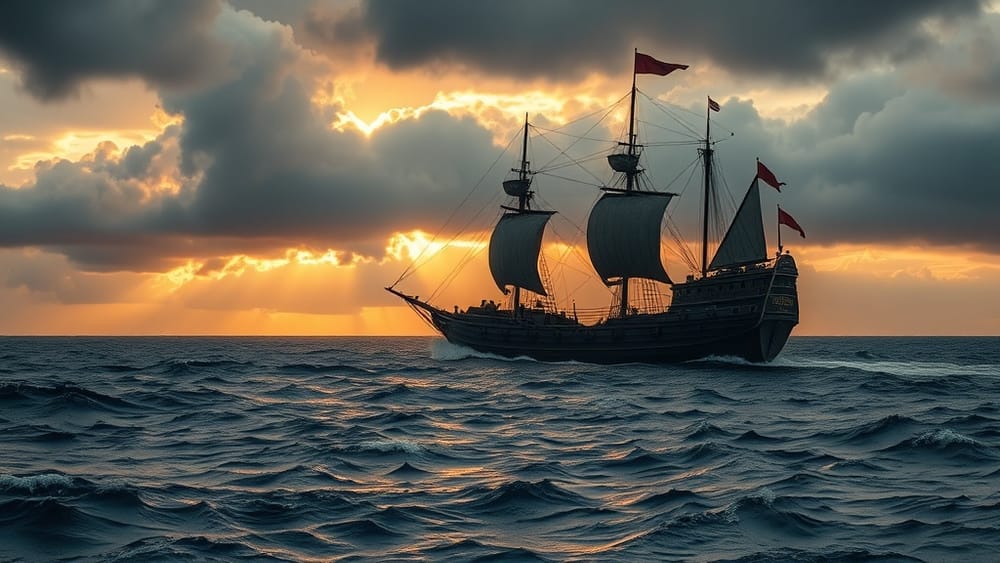
On July 17, 2026, Christopher Nolan releases The Odyssey — no subtitle, no shared universe, no safety net. A studio epic built on a 2,700-year-old poem, shot in IMAX 70mm, and arriving at the peak of a summer season that has been, for the better part of a decade, the exclusive property of sequels, reboots, and IP extensions. The question Nolan is forcing onto the industry is not whether Homer translates to screen — it clearly does, in fragments, in echoes, in every hero's-journey scaffold Hollywood has leaned on since Campbell. The question is whether a single director's vision, unanchored from franchise machinery, can command a $200-million opening weekend in 2026.
Nolan's commercial track record is the obvious counter-argument to any skepticism. Oppenheimer (2023) grossed over $950 million worldwide on the back of a three-hour biographical drama about a physicist's moral collapse — a film that, by every conventional metric of summer programming, should not have worked at that scale. Before that, Tenet (2020) managed $363 million during a pandemic-fractured theatrical landscape. Dunkerque (Dunkirk, 2017) crossed $500 million with almost no traditional protagonist. His films do not follow the rules of tent-pole economics, and they succeed anyway. That history matters. But it also sets a trap: each Nolan release is now measured against the last, and the bar has moved to a place where anything short of Oppenheimer reads as underperformance.
The Weight of the Source
What makes The Odyssey a genuinely different proposition is the source material's simultaneous familiarity and resistance. Every educated audience member carries a version of Odysseus — cunning, ruthless, exhausted, unfaithful, brilliant. That cultural pre-loading is an asset. It eliminates the exposition burden that buries many original screenplays and gives Nolan's characteristic non-linear architecture something to work against. Homer's poem is already structured around anachronism: Odysseus tells his own story inside the story. Nolan has spent his career building narrative machines that fold time back on itself; the Odyssey is, in that sense, source material written for him.

The resistance lies in scale and abstraction. The Homeric world is simultaneously intimate — a husband trying to get home, a wife holding a household together through two decades of siege — and cosmically indifferent, populated by gods who intervene for reasons of pride rather than morality. Translating that theological architecture into a two-and-a-half-hour IMAX experience requires Nolan to make choices that will alienate some classical readers regardless of their validity as cinema. Compression is violence against epic poetry. It is also, sometimes, the condition of great adaptation.
IMAX 70mm as Argument
The format choice is not incidental. Shooting in IMAX 70mm — a process that produces images of extraordinary resolution and aspect-ratio expansion — is Nolan's consistent method of insisting on the theatrical experience as irreplaceable. It worked as a statement with Dunkerque, where the format made the English Channel feel like a planetary boundary. It worked with Oppenheimer, where Trinity's detonation became something closer to a geological event than a historical one. Applied to the Mediterranean world of the Odyssey — to the Cyclops's cave, to Circe's island, to the straits between Scylla and Charybdis — the format promises images that streaming cannot replicate at home. That promise is, structurally, an argument against the platform-first consumption pattern that has flattened theatrical attendance for everything outside the Marvel pipeline.
The studios watching The Odyssey's release are watching something else: proof of concept. If a non-franchise, non-sequel epic built around classical literature can hold a summer box office position against whatever IP machinery surrounds it in July 2026, it reopens a conversation the industry mostly stopped having after the mid-2000s — that original cinema can be event cinema. If it falls short, the lesson drawn will be the opposite, and the pressure on the remaining auteur directors who operate at this scale will increase accordingly.
What Nolan Is Actually Risking
The deeper stakes are reputational rather than financial. Universal is financing an expensive film by a proven director — the downside risk is manageable within a diversified studio slate. What Nolan is risking is the argument he has been making implicitly since Memento (2000): that complexity and scale are not mutually exclusive, that an audience exists for cinema that demands something in return. The Odyssey is the most ambitious version of that argument he has yet constructed. Homer doesn't condescend. Neither does Nolan. Whether the summer multiplex — in 2026, after years of algorithmic content and franchise fatigue — is ready to meet that argument on its own terms is the only question that matters.
The sea is wide. Ithaca is far. We'll know in July.