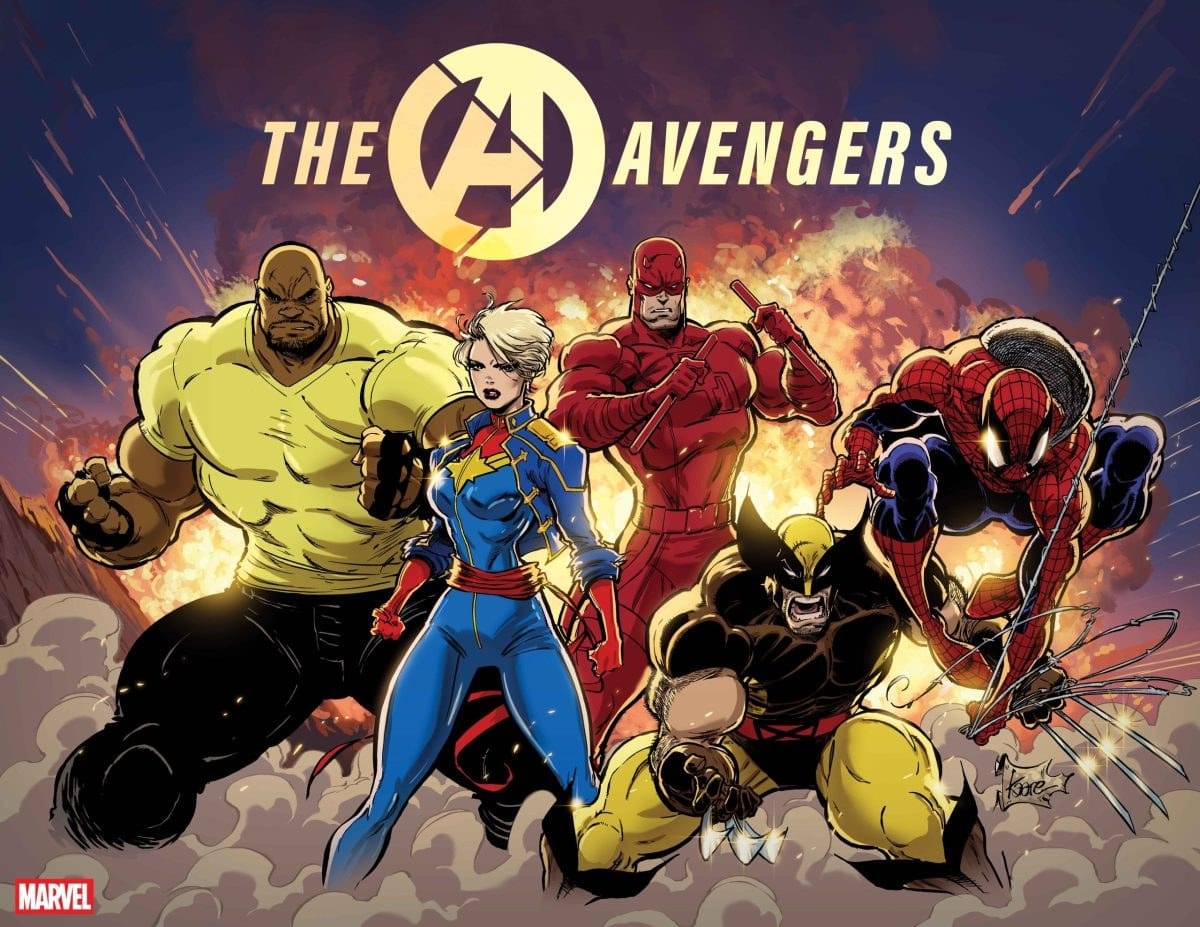
Avengers (2026) #1 ships today. Written by Chip Zdarsky with art and cover by Marco Checchetto, priced at $5.99 for 39 pages, it is the first issue of the new ongoing that Marvel's editorial apparatus has positioned as the beating heart of the publisher's line going forward. The team on the cover: Captain Marvel, Spider-Man, Daredevil, Wolverine, Luke Cage, and Miracleman — specifically David Colton, a character Zdarsky himself created and shepherded to this exact moment. That is not an accident. That is a long game.
Start with the branding. The new team is marketed as "Earth's Mightiest Survivors" — a deliberate break from every aspirational relaunch tagline the franchise has deployed for sixty years. "Earth's Mightiest Heroes" is a declaration of authority; "Earth's Mightiest Survivors" is a confession. It tells you where the world stands after Avengers: Armageddon (2026) before you open a single page. Marvel doesn't usually lead with its wounds this publicly. The fact that it does here is both the clearest signal of what Zdarsky is building and the most honest piece of marketing the line has produced in years.
The Armageddon Foundation
Avengers: Armageddon is the five-issue limited series — written by Zdarsky with artists Delio Diaz and Frank Alpizar — that dismantles the previous status quo and deposits the rubble at the doorstep of this ongoing. The world order has been completely rewritten. A broken humanity actively fears and distrusts the team. When the dust from that event settles, a demonic invasion erupts on Earth, and six heroes — only some of whom would have been in the same room before — assemble to answer it. The structural move is classical: destroy, then rebuild on an altered foundation. What is less classical is how deep the destruction runs before Zdarsky calls for a rebuild. Zdarsky described this lineup as "angry as hell and ready to avenge," which is not how you talk about a team that feels secure in its mandate.
The comparison point that keeps surfacing in coverage is Brian Michael Bendis's Avengers: Disassembled, the 2004 crossover that saw the destruction of the existing traditional roster and the exile of several key members of the team. Bendis and penciler David Finch's story was a means to an end — it cleared the deck so New Avengers could exist. Disassembled defined the opening of the Bendis era, but it was essentially demolition work in service of a new blueprint. What Zdarsky is attempting with Armageddon into Avengers #1 carries similar structural weight, but with a crucial difference: he isn't just changing the roster. He is changing the team's relationship with the world that it operates in. A team that humanity no longer trusts cannot function the same way a team that humanity lionizes can. The genre logic shifts. The threats that matter shift. The cost of action shifts.
Why This Roster Is Not Arbitrary
On paper, Captain Marvel, Spider-Man, Daredevil, Wolverine, and Luke Cage reads like a street-level recalibration with one cosmic anchor. That is precisely the point. Disassembled cleared out the gods and the monarchs and left behind a messier, more morally exposed group. Zdarsky does something similar here, but the street-level weight is heavier and more intentional. Daredevil and Luke Cage are not here for cosmetic grit — they are here because a team operating in a world that has turned against it needs people who know how to function without institutional approval. These are characters who have been doing exactly that for most of their publication history.
Then there is Miracleman. David Colton, the former Captain America introduced in Zdarsky's acclaimed Captain America run, inherited Miracleman's legacy and extraordinary power in Avengers: Armageddon #4, which published on September 16, 2026. That issue is where Colton, through an origin box, acquires powers traced to Miracleman of another reality and takes up the mantle. Marvel confirmed the character as the sixth and final member of the new lineup, updating Checchetto's main cover to feature Miracleman standing alongside the team. The updated roster also triggered a wave of variant covers — including a blind-bag exclusive piece by Miracleman veteran Alan Davis — that underscores how seriously Marvel is treating the integration.
Miracleman as Publishing Statement
Miracleman's history at Marvel is long, litigious, and often stalled. From 2014 onward, Marvel began reprinting the revival material using the Miracleman name, and in 2022 began continuing the story. For years the character occupied a peculiar shelf — canonical enough to reprint, too legally fraught and tonally extreme to easily integrate. Miracleman, in his original Alan Moore and Neil Gaiman iterations, is a character whose power level and moral complexity resist easy team-book placement. A being who once rebuilt civilization from the wreckage of a super-powered war does not slot naturally into a six-person ensemble where everyone takes turns punching.
What Zdarsky has done — and this is where the creative decision carries genuine publishing weight — is solve that problem by creating his own version. David Colton is not Michael Moran. He is a character Zdarsky built from scratch inside the Marvel universe, given a specific history, a specific psychology, and a specific set of loyalties. The 2026 Miracleman is a soldier turned super-soldier who receives the powers of a Michael Moran from another reality. The name carries the mythology. The person underneath it is new. That distinction matters enormously. It means Zdarsky can use the resonance of the Miracleman legacy — the weight of what that word means to readers who remember Moore's run, or Gaiman's "Golden Age," or the legal battles — without being shackled to the specific continuity that makes those stories so resistant to mainstream Marvel integration. Marvel gets the iconography and the fan response. Zdarsky gets a character he fully controls narratively. It is one of the cleaner solutions to a long-standing problem this publisher has produced.
The fifth and final issue of Avengers: Armageddon dropped October 21, leaving the stage set. What Avengers #1 inherits is a Marvel Universe where the conventional power structures have fractured, where the team's relationship with humanity is adversarial rather than celebratory, and where its most powerful member is a man holding a legacy he barely has time to understand. That last detail — the unpredictability of David Colton, explicitly flagged in Marvel's own solicitation copy — is the dramatic engine. "The unpredictable David Colton may not be able to be trusted with his godlike new abilities." An Avenger the team itself cannot fully trust is a pressure point that will drive every interpersonal dynamic in the book. Zdarsky knows this. He built the pressure point himself.
Zdarsky and Checchetto: The Architecture of a Known Partnership
The creative reunion at the center of this relaunch is not incidental. In November 2018, it was announced that Zdarsky would write Daredevil with Marco Checchetto as artist, launching a run that stood shoulder to shoulder with the works of Frank Miller and Brian Michael Bendis in the character's canon. That collaboration eventually produced two volumes of an ongoing series, a crossover event in Devil's Reign, and a reputation as one of the most formally disciplined long-form superhero runs of the 2020s. The Eisner nomination that followed was not a surprise to anyone who read it issue-by-issue. Checchetto's linework rewards density — his figures carry physical weight, his compositions account for emotional subtext, his action sequences land with consequence. These are exactly the qualities a post-apocalyptic team book needs.
The reunion carries its own implicit argument: Zdarsky and Checchetto together are not a relaunch gimmick. They are a functioning creative unit with an established shorthand and a proven ability to sustain a long-form narrative under institutional pressure. Editor Wil Moss has described the new Avengers as striking "just the right balance of quality AND spectacle" — which is precisely what a book trying to be both accessible and structurally serious must do to survive as a monthly flagship. The challenge is real. Flagship titles bleed readers when they prioritize spectacle over character and hemorrhage casual audiences when they get too insular. Avengers under this team is betting on the middle path.
What ships today is not merely a #1 with a recognizable logo and a new lineup. It is the opening chapter of what Zdarsky has been architecting — across Captain America, across Armageddon, across the deliberate construction of David Colton — since he began building toward this specific moment. The Miracleman decision is the most visible sign of that architecture. But the real question Avengers #1 answers is simpler and harder: whether a flagship Marvel title can hold the line between emotional seriousness and commercial velocity, month after month, with a cast of survivors who have every reason to be angry and no guarantee that anger alone is enough. That question will take years to fully answer. It starts today.
For more on recent developments at Marvel's street-level and cosmic corners of the universe, see our coverage of Alien vs. X-Men #2 and the February 2027 Midnight Universe solicitations.