There is a particular kind of anticlimax built into every digital release date announcement. The press release arrives, the platforms light up, and something that felt like a collective cultural event — a reason to leave the house, to queue, to experience alongside strangers — becomes an item in a subscription menu. For most films, that translation is fairly seamless. For The Odyssey (2026), it is something stranger. What arrives on digital platforms today, November 17, is the highest-grossing R-rated film in cinema history, the biggest IMAX release ever made, and the clearest argument in years that the theatrical experience still commands a kind of authority no living room can replicate. Knowing all that doesn't make the home window feel lesser. It makes it feel like a different object entirely.
 Official trailer
Universal confirmed the digital release date alongside a simultaneous 4K Ultra HD and Blu-ray drop — a relatively rare move for a major studio tentpole, and one that reflects both Nolan's well-documented preference for physical media and a release strategy that skips the conventional premium video-on-demand window. You can rent or purchase the film today on Apple TV and Prime Video. A subscription streaming date — almost certainly Peacock — has not yet been announced. The window between theatrical debut (July 17) and today is exactly four months, mirroring the approach Universal and Nolan took with Oppenheimer (2023), which spent 123 days in theaters before its home release.
The numbers that frame this moment are worth stating plainly, because they are genuinely without precedent. As of November 9, The Odyssey had grossed $626 million domestically and $1.179 billion internationally, for a worldwide total of $1.804 billion — making it Nolan's highest-grossing film, the second-highest-grossing film of 2026, the highest-grossing film ever distributed by Universal, and the eleventh-highest-grossing film in cinema history. The R-rating alone is a remarkable qualifier: the film surpassed Deadpool & Wolverine's $1.338 billion during its sixth weekend of release, becoming the highest-grossing R-rated film of all time, and later became the first R-rated film in history to gross $1 billion at the international box office. The film cost $250 million to make — Nolan's most expensive production to date — and it has returned more than seven times that sum.

The IMAX story is its own chapter. The Odyssey became the highest-grossing IMAX release of all time with $289 million, overtaking Avatar (2009), which had held the record with $271 million. It achieved that milestone in less than a month of play. IMAX delivered four consecutive weekends of $50 million-plus globally during the film's run — a streak that had no precedent: prior to The Odyssey, IMAX had never managed even two such weekends back-to-back. IMAX screens accounted for more than 26% of the film's overall global box office across its run, a figure that underlines how fundamental large-format exhibition was to the film's commercial identity, not merely its aesthetic one.
What made those IMAX numbers possible was a production gamble that paid off in ways nobody fully anticipated. The Odyssey is the first theatrical feature ever shot entirely with IMAX cameras. Nolan and cinematographer Hoyte van Hoytema collaborated with IMAX to develop a next-generation film camera called The Keighley, along with a new sound blimp compatible with multiple IMAX film cameras, which together shot a total of 2.1 million feet of IMAX film. To put that in physical terms: Nolan's previous film Oppenheimer famously required 11 miles of IMAX film for its print; The Odyssey's raw footage surpassed that by an order of magnitude. Nolan reportedly convinced IMAX to make its cameras lighter and 30% quieter, enabling a full 91-day ocean shoot on practical locations — aboard actual vessels, in actual seas. The commitment to on-location, practical filmmaking was total. Much of the film was shot at sea, with the cast who play Odysseus's crew placed on real waves at real locations.
The cast assembled for the project is worth cataloguing: Matt Damon leads as Odysseus, with Tom Holland as Telemachus, Anne Hathaway, Robert Pattinson as Antinous, Lupita Nyong'o, Zendaya, Charlize Theron, and Samantha Morton rounding out an ensemble of unusual weight and range. The film is an adaptation of Homer's ancient Greek epic, following Odysseus's decade-long attempt to return home to Ithaca after the Trojan War — his encounters with the Cyclops Polyphemus, the Sirens, Calypso, and the mythological forces that conspire to delay and destroy him. Nolan, who has acknowledged dreaming of making this film for decades, studied multiple translations before settling on what has been described as a realistic interpretation of Greek mythology, drawing inspiration from Andrei Tarkovsky's Andrei Rublev (1966) and Akira Kurosawa's Ran (1985), as well as the practical effects work of Ray Harryhausen.
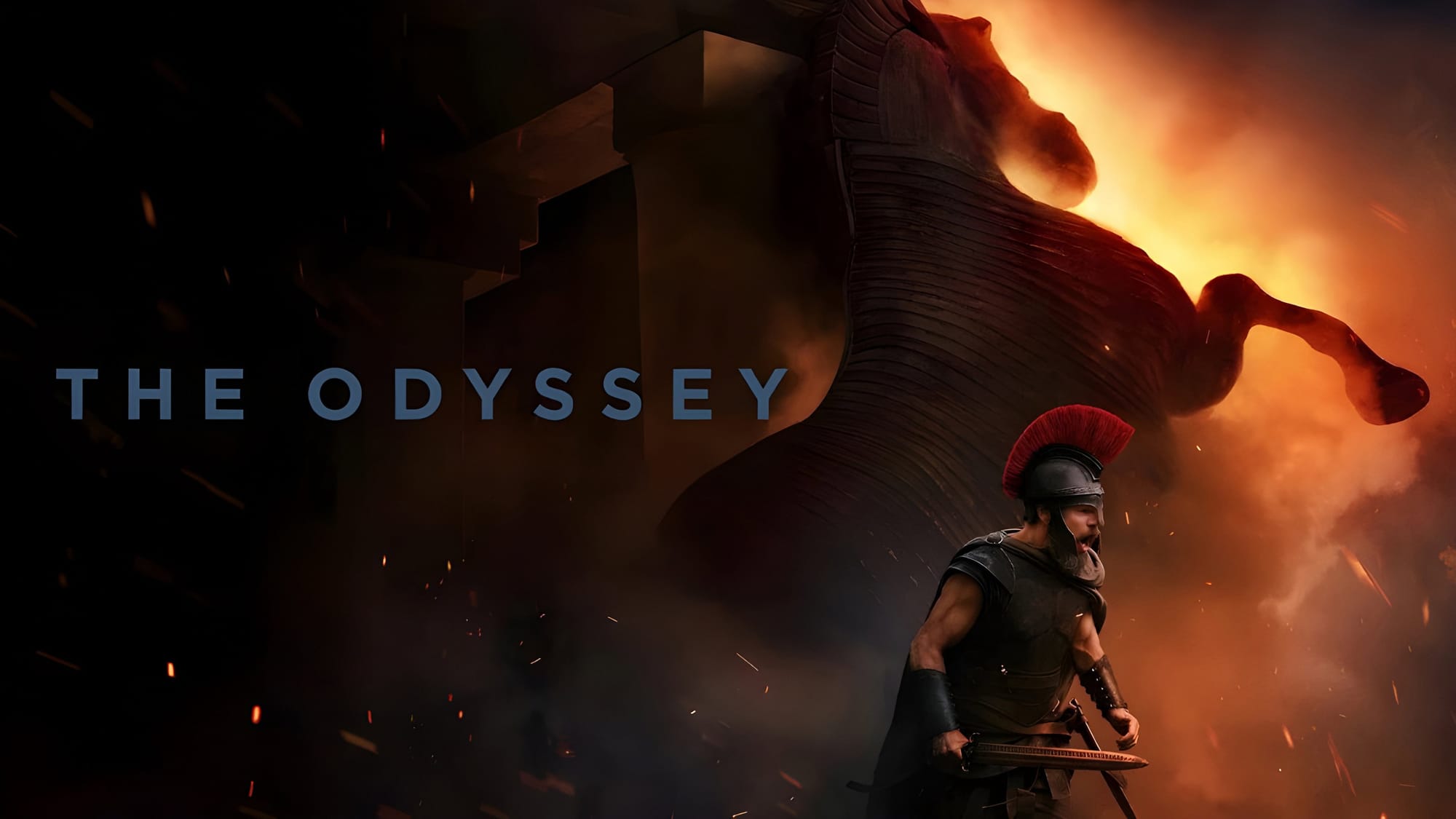
The critical reception has been broadly enthusiastic — particularly for its direction, ensemble performances, and the scale of its set pieces — though some critics took issue with Nolan's deviations from the source material. The film carries an A CinemaScore. It is currently positioned as a significant awards contender ahead of next year's season, and the digital arrival today was always part of that calculation: voters need to be able to watch the film at home, and The Odyssey is now available to them on the same day as the general public.
What is genuinely worth sitting with, as the film moves into its home window, is the question of what its theatrical performance revealed about the state of cinema — and what the digital arrival now confirms. The Odyssey's run was not a fluke of IP nostalgia or franchise mechanics. Homer's Odyssey has no Marvel continuity to leverage, no sequel to tease. What it had was a filmmaker operating at the absolute peak of his technical and narrative ambition, a format that demanded physical presence, and an audience that responded to both. The opening weekend of $264 million worldwide — Nolan's best ever, surpassing The Dark Knight Rises's $249 million — was built on that combination. So was every weekend that followed.
The home window is not a diminishment of that. It is simply the next phase of a film's life — the moment when the collective experience fractures into private ones, when the shared darkness of the cinema gives way to individual rooms, individual pauses, individual rewinds. For a film like The Odyssey, that transition carries a specific texture. The IMAX ratio, the full-frame compositions Nolan and van Hoytema built for the largest screens on earth, will be compressed onto televisions and laptops of wildly varying quality. Some of that will be lost. What won't be lost is the film itself — the story of a man trying to get home through a world determined to stop him, told by a director who shares something of that same stubborn, long-horizon commitment to the medium he works in. The Odyssey was always going to be a different film at home. Today, we find out how much of it survives the journey.
For further reading on how landmark films reshape the terms of their own reception over time, see our piece on the lasting structural impact of Moonlight at ten years, and on how the infrastructure of film taste itself is being reorganized, our analysis of the NYT's acquisition of Letterboxd.