On November 11 and 12, at EPCOT's America Gardens Theatre in Orlando, something happened that had never happened in sixty-five years of touring: the Beach Boys played without a single founding member on the stage. The shows had originally been billed as the Beach Boys featuring John Stamos. What Disney advertised instead — after the band canceled all remaining 2026 dates — was John Stamos and the California Sound. The swap was tidy. The implications were not.
The EPCOT performance was notable for being the first ever Beach Boys show not to feature any of their founder members: Love, the Wilson brothers, or Al Jardine. That is not a small thing to absorb. The Beach Boys were originally comprised of the three teenaged Wilson brothers — Brian, Carl, and Dennis — their cousin Mike Love, and school friend Al Jardine, all formed in Hawthorne, California, in 1961. For more than six decades, something from that original core was always on the stage. Now nothing is.
The chain of departures was long and painful. Dennis Wilson died in 1983, drowning at Marina Del Rey. Carl died in 1998 of lung cancer. Following Carl's death, Jardine left the band, and the members granted Love exclusive legal rights to tour under the Beach Boys name. Brian Wilson — the architect, the genius, the man whose studio obsessions gave the group its lasting weight — died on June 11, 2025, at home in Beverly Hills. After decades of physical and mental health challenges, he succumbed to respiratory arrest. He was 82. Then, in March 2026, Bruce Johnston, a part of the Beach Boys for 61 years, revealed he was leaving the touring band, making Mike Love the last remaining classic-era member on the road.
That left Love — 85 years old, the holder of the licensed touring rights, the last man standing — as the sole thread connecting the brand to its origins. And then that thread began to fray. The Beach Boys cancelled the vast majority of their concerts over the past few months as Love battles a medical ailment that left him gaunt and unable to stand or sing at their last few shows. A frail-looking Love took the stage for shows in Cincinnati and Nashville, and Stamos wrote in an Instagram post that Love insisted on being there despite his health problems. Stamos wrote: "I've played with Mike for 41 years. I never imagined how deeply it would affect me to see someone larger than life face something so human and fragile."
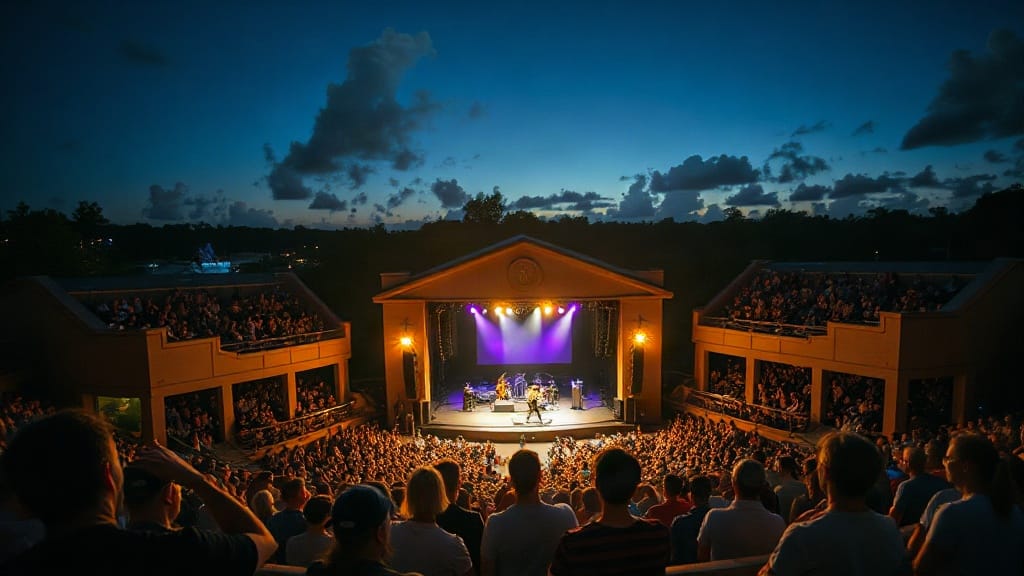
When the EPCOT dates arrived with Love unable to perform, the show went on under a different banner. Stamos rechristened the group John Stamos and the California Sound for the occasion, acknowledging Love's absence from the stage and saying: "Before we go any further, we want to send some love to our dear friend Mike Love. I can't think of a better way to send him love than with a little California Sound." The group played just four Beach Boys songs — "California Girls," "Fun Fun Fun," "Kokomo," and "Forever." That gave the group time to play nine songs over 30 minutes at each show.
The name "California Sound" is not an accident. It is both a compliment and a legal maneuver. The Beach Boys are known for their musical ingenuity, vocal harmonies, and lyrics reflecting Southern California's youth culture of surfing, cars, and romance — dubbed the "California sound." By invoking the aesthetic instead of the brand, Stamos found a way to perform the catalog without triggering a trademark dispute and without pretending to be something the ensemble definitively is not. It was careful. It was gracious. And it also exposed, quietly, how thin the fiction of "the Beach Boys" had already become before this moment.
Consider what that brand actually contained by the time the EPCOT shows arrived. As of 2026, the only principal member included in the Beach Boys' touring band had been co-founder Mike Love. Brian Wilson had not toured with Love's version of the band since the 2012 50th anniversary reunion. Johnston joined in 1965, when Brian Wilson stepped away to focus on solo work — himself a late addition, now also gone. Chris Cron, who fronts the Beach Boys tribute act Pet Sounds Live, had already been announced as Johnston's replacement. The touring entity was, in honest terms, a licensed tribute act helmed by one original member. The music was real. The performances were earnest. But the metaphysical weight of the name had been distributed unevenly for a long time.
Stamos's relationship with the group is real and deep, which makes his position both easier and more complicated. His longstanding relationship with the Beach Boys dates back to July 4, 1985, when he played his first official show with the band at the Washington Monument, for close to a million people. He began performing with the band in 1985, playing the drums and other percussion instruments in Beach Boys concerts. He appeared in their music videos, sang lead vocals on recordings, and built a parallel public identity around the association. He is not an outsider dressed in someone else's clothes. He is, in every practical sense, a long-serving member. But he is not a founder. He is not a Wilson. And the brand has always traded on that specific inheritance.
The question the EPCOT weekend raises is not whether Stamos can front this music — he clearly can, and the audience clearly responded. The question is whether "the Beach Boys" should continue to exist as a touring entity at all if Love's health does not recover sufficiently, or whether that question has already been answered and simply not announced. The California Sound billing offers a possible model for keeping the music onstage without using the Beach Boys name. That is a dignified solution. It is also a tacit admission that the name and the thing it names have come apart.
This is not a problem unique to this band. Brand persistence after founding membership has been a structural feature of the music industry for decades — from the Drifters to Jefferson Starship to Lynyrd Skynyrd, lineups have been substituted while names have endured. What makes the Beach Boys different is the specificity of the mythology. The music is not simply product. It is autobiographical. Pet Sounds (1966) is the sonic record of Brian Wilson's inner life. "Good Vibrations" is a document. "God Only Knows" is a gift from one specific human mind. That content does not vanish because the touring band changes, but the idea that any configuration of musicians standing on a stage constitutes "the Beach Boys" becomes more implausible with every passing departure.
Where this leaves the Beach Boys as an entity remains unclear. Three more EPCOT Center shows were scheduled for the following days, but the future for both the Beach Boys and John Stamos and the California Sound is extremely murky. Mike Love may recover. The touring band may reconvene under the original name. Ideally, Love will be in better shape at some point and be once again able to front the Beach Boys. If not, it might be another chance for John Stamos and the California Sound to strut their stuff. That framing — if not — carries more weight than it might seem. It describes a contingency that is quietly becoming a default.
The California Sound played four Beach Boys songs at a Disney World food festival in November 2026. That is the sentence history will carry forward from this week. What it means depends entirely on what comes next. If Love recovers and returns, it will be a footnote — an unusual show during a difficult stretch. If he does not, those four songs at EPCOT will be remembered as the moment the band's name and the band's reality finally, formally diverged. The endless summer, it turns out, was always going to end. The only question was what it would look like when it did.